- Email:info@tsv-valve.com


 Jul 08,2026
You’re monitoring your system gauges, and something’s off. The pressure drop has crept up. Flow is down. The pump is starting to cavitate. Chances are, your Y-Strainer is clogged.
A Y-strainer is a filtration device used in piping systems to remove solid particles, debris, and other contaminants from liquids, gases, or steam. It protects downstream equipment like pumps, valves, and meters from damage caused by debris. But when it clogs—especially if it clogs quickly—it creates a cascade of problems: reduced flow, increased energy consumption, equipment wear, and unplanned downtime.
This article walks you through the symptoms of a clogged strainer, the four root causes of rapid clogging, a preventive maintenance schedule you can implement immediately, and on-site cleaning procedures that minimize disruption. By the end, you’ll have a clear framework for keeping your strainer—and your system—running smoothly.
You don’t need to open the strainer to know it’s clogged. The pressure gauge tells you everything.
When the strainer is clean, the pressure drop across it should be minimal—typically less than 5 psi differential. This is your baseline. Record it when the system is first commissioned and after each cleaning.
When the pressure differential reaches 5 to 6 psi, it’s time to clean the strainer. At this point, the screen is partially blocked, and system efficiency is already compromised. Don’t wait until it gets worse—a 5 psi drop is your warning sign.
If the pressure differential exceeds 15 psi, the strainer is critically clogged. Stop the system immediately and clean the strainer before restarting. Operating at this level risks cavitation, pump damage, and even strainer failure. As a general rule, the pressure drop should not be allowed to go over 30 psig.
A Y-strainer doesn’t clog quickly without a reason. These are the four most common culprits.
During system commissioning, pipelines are full of weld slag, rust, scale, and gasket fragments. These large particles hit the strainer screen and clog it almost immediately. A permanent Y-strainer is not designed to handle this kind of shock load.
Solution: Install a temporary start-up strainer during system flushing and commissioning. Remove it once the system is clean. This protects your permanent strainer and keeps it from clogging before production even starts.
Using a screen with openings that are too small for the fluid’s debris load causes rapid clogging. A 100-mesh screen will clog much faster than a 40-mesh screen, but it also filters finer particles. The wrong mesh size for your application is one of the most common—and most avoidable—causes of frequent clogging.
Solution: Calculate the minimum particle size you actually need to capture. For water systems, 20-40 mesh is standard. For finer filtration, you may need a coarser mesh than you think—the goal is to capture harmful particles, not every speck of dust.
An undersized strainer has insufficient screen area for the system’s flow rate and debris load. The screen fills up quickly, and the pressure drop rises fast. The result is frequent cleaning cycles and high maintenance costs.
Solution: Recalculate the housing size based on your system’s flow rate and acceptable pressure drop. A larger strainer has more screen area, which means longer intervals between cleanings.
New solids in the fluid—from a change in raw materials, upstream processes, or seasonal variations—can overwhelm a strainer that was previously adequate. The strainer hasn’t changed; the process has.
Solution: Upgrade to a basket strainer for higher debris capacity, or consider an automatic self-cleaning strainer for continuous operation. Basket strainers hold considerably more material than Y-strainers and offer lower pressure drop, making them better suited for debris-heavy applications.
A regular maintenance schedule prevents clogging before it becomes a problem.
Walk the line once a week and read the differential pressure gauge. If it’s creeping up, you know cleaning is coming. This five-minute check is the most effective prevention measure you can take.
For systems with clean media, record the pressure drop immediately after cleaning and again when the strainer is due for cleaning. Compare these readings over time. If the “clean” pressure drop is increasing, the screen is wearing out or the system is getting dirtier.
For systems with dirty media, schedule a planned offline cleaning or screen replacement every quarter. Don’t wait for the pressure gauge to tell you it’s too late. A planned cleaning takes an hour; an emergency shutdown takes a day.
You don’t always have to shut down the entire line to clean a Y-strainer. Here’s how to do it efficiently.
If your strainer is equipped with a blow-down valve, open it to back-flush accumulated debris while the system remains online. The pressure differential pushes debris out through the valve. This is the quickest way to clear a partially clogged strainer without interrupting flow.
Some Y-strainers have a flush port at the bottom of the strainer body. Connect a hose and open the port to flush out settled sludge and heavy debris. This is particularly effective for systems with high solids content where debris settles at the bottom of the strainer pocket.
What is the difference between a Y-strainer and a basket strainer in terms of clogging?
Y-strainers are compact but have smaller screens that clog faster, requiring more frequent maintenance. For the same mesh size and flow rate, a Y-strainer typically produces 2 to 5 times higher pressure drop than a basket strainer. Basket strainers hold considerably more debris and offer lower pressure drop, making them better for high-flow, debris-heavy pipelines. Y-strainers are still the best choice for smaller lines, gas systems, and applications where space is limited.
Can I operate without a strainer temporarily?
The risk is extremely high. Operating without a strainer exposes downstream equipment—pumps, control valves, meters—to debris that can cause immediate damage. A single piece of weld slag or rust can score a pump impeller or jam a control valve. Don’t bypass the strainer; clean it instead.
What mesh size is standard for water systems?
For general water systems, 20-40 mesh is standard. For finer filtration, higher mesh counts are available, but they come with higher pressure drop and more frequent cleaning. For steam and gas systems, coarser mesh (10-20 mesh) is common to minimize pressure drop.
The Y-strainer’s design is simple—a Y-shaped body housing a filter screen—but the choice of materials and specifications matters.
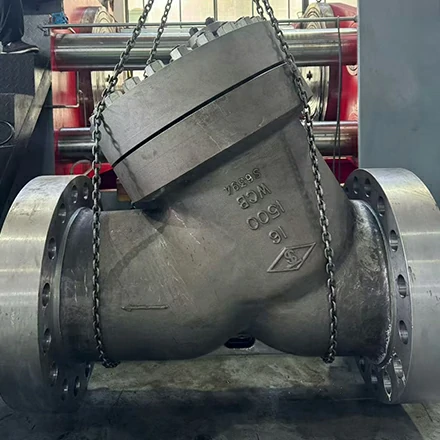
TSV Valve manufactures Y-strainers with a strong focus on raw material integrity and quality assurance. Their CF8M Y-Strainer is constructed from premium certified materials that meet API/ASTM standards. CF8M is the cast equivalent of 316 stainless steel, offering excellent corrosion resistance for demanding applications in water treatment, chemical processing, oil and gas, and HVAC systems.
TSV’s strainers are available with multiple end-connection options—threaded, flanged, and welded—to suit different pipeline setups. The company’s quality assurance process includes advanced equipment to verify machining accuracy and rigorous performance testing. Every valve is backed by full traceability and test reports. Packaging in robust, export-grade wooden boxes ensures safe international delivery.
A Y-strainer that clogs too often is a symptom, not the problem itself. The root cause is almost always one of four issues: start-up debris, incorrect mesh size, undersized housing, or a process change that introduced new solids. With the right diagnosis and a preventive maintenance schedule—weekly gauge checks, monthly baseline recording, and quarterly planned cleaning—you can keep your strainer running clean and your system running smoothly. TSV’s CF8M Y-Strainer offers the material quality and manufacturing precision to handle demanding applications with minimal clogging and maximum reliability.
Ready to solve your Y-strainer clogging issues? Reach out to TSV Valve’s technical team—they can provide strainer sizing guidance, mesh selection recommendations, and maintenance best practices for your specific application.
Related News


E-mail: info@tsv-valve.com

Telephone: +86-13695850057

Whatsapp: +86-13695850057

Address: TianSheng Industrial Park,Dong'ou Industrial Zone,Oubei Town,Wenzhou City,Zhejiang Province,China