- Email:info@tsv-valve.com


 Jul 16,2026
You’re watching the DCS screen, and the flow or pressure trend line looks like a roller coaster—up, down, up, down, never settling. That‘s control valve hunting, and it’s one of the most frustrating problems in process control.
A Control Valves system is essential for maintaining optimal process conditions in industrial applications, but when it starts oscillating, it affects product quality, wastes energy, and can even damage downstream equipment. The oscillation can come from mechanical friction, pneumatic issues, or incorrect sizing. This guide walks you through a systematic diagnostic approach—from visual identification of the hunting pattern to mechanical, pneumatic, and process-related fixes. For process control engineers and instrument technicians, this is a practical framework for getting your control valve back to stable regulation.
The first step in fixing control valve hunting is recognizing what kind of oscillation you’re dealing with. The pattern on the trend line tells you where to look.
Underdamped hunting appears as a decaying oscillation. The process variable overshoots the setpoint, swings back, overshoots again with less amplitude, and gradually settles. This pattern is a classic sign of a control loop that’s trying too hard—typically caused by a positioner gain that‘s set too high.
Limit cycle hunting presents as a steady, uniform-amplitude sine wave on the trend line. The oscillation doesn’t decay—it continues indefinitely at the same amplitude. This pattern is almost always caused by excessive friction in the valve, often referred to as “stiction” (static + kinetic friction). The valve sticks, the controller increases the output signal to overcome the friction, the valve jumps, the process overshoots, and the cycle repeats.
Diagnosing the hunting pattern correctly directs your troubleshooting efforts. Underdamped oscillation points to the controller or positioner settings; limit cycle oscillation points to mechanical issues inside the valve. Get this wrong, and you’ll waste time adjusting the wrong part of the system.
If you’re seeing a limit cycle oscillation—the steady, repetitive sine wave—the problem is almost certainly mechanical friction.
The valve stem moves through a packing gland that seals the process fluid. If the packing is too tight, or if it‘s dried out and hardened, it creates excessive friction. The valve sticks in position until the actuator builds enough force to break it free—then it jumps, causing the oscillation.
The fix: Check the packing gland. Try loosening the packing nuts slightly to reduce friction. If the packing material is dried or aged, replace it with fresh packing. A small amount of lubrication on the stem (compatible with the process) can also help. A stuck valve stem is the single most common cause of control valve hunting.
Stiction is the combination of static friction (the force required to start moving) and kinetic friction (the force required to keep moving). When static friction is significantly higher than kinetic friction, the valve jumps when it finally breaks free. The jump creates an overshoot, and the cycle repeats. Stiction can be difficult to diagnose without specialized valve diagnostic tools, but there are field indicators: if the valve responds in sudden jumps rather than smooth movement, stiction is the likely culprit.
The fix: If lubrication and packing adjustment don‘t solve the problem, you may need to increase the actuator’s thrust to overcome the friction. Alternatively, replace the packing with a low-friction alternative. In severe cases, the valve internals may need to be inspected and serviced.
A simple field test for mechanical friction: manually stroke the valve from the positioner or handwheel. If the valve moves in abrupt jumps rather than smoothly, friction is excessive. Listen for any grinding or scraping sounds. The TSV control valve is designed with premium raw materials to ensure smooth operation, but even the best valve needs proper maintenance.
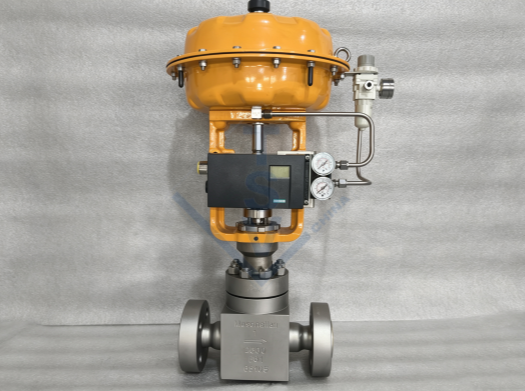
If the valve moves smoothly but the loop is still hunting, the problem is likely in the pneumatic control system or the positioner.
A positioner gain that’s set too high amplifies small errors into large corrections. The valve overshoots, the controller backs off, the valve undershoots, and the cycle repeats. This is the most common cause of underdamped hunting.
The fix: Reduce the positioner gain setting. Many modern smart positioners have adjustable gain or proportional band settings. Lower the gain incrementally and observe the response. If the positioner has an auto-tuning function, run it—it will often find the optimal gain setting automatically.
The positioner needs a stable instrument air supply. If the supply pressure fluctuates, the positioner output fluctuates, and the valve position fluctuates. This creates a hunting pattern that can look like either underdamped or limit cycle oscillation depending on the fluctuation frequency.
The fix: Check the instrument air supply pressure at the positioner. Install a pressure regulator if needed. Add a small air receiver tank (volume booster) to smooth out pressure fluctuations. TSV provides additional services including installation and maintenance support.
The signal line from the I/P converter to the positioner carries the control signal. A small leak—from a cracked tube, a loose fitting, or a degraded O-ring—can cause the signal to fluctuate. The positioner responds to the fluctuating signal, and the valve hunts.
The fix: Perform a soap bubble test on all signal line connections. Look for bubbles that indicate air leaks. Tighten fittings, replace cracked tubing, and check O-rings. Even a tiny leak can cause significant hunting.
Sometimes the valve is mechanically sound, the positioner is tuned correctly, and the air supply is stable—but the valve still hunts. The problem may be in the valve sizing or the process itself.
An oversized valve operates at a small opening for most of its control range. At small openings, the control characteristic is highly sensitive—a small change in valve position causes a large change in flow. This sensitivity amplifies any minor variations in the control signal, creating oscillation.
The fix: The only effective solution is to reduce the valve size or install a smaller trim. If the valve is significantly oversized, replace the valve body or install a reduced trim (cage or plug) that matches the process flow requirements. This is a permanent fix that requires engineering evaluation.
Some processes respond very quickly to control changes—pressure loops, for example, or small-volume flow loops. A fast process combined with a standard PID tuning can create oscillation.
The fix: Adjust the PID tuning. Add derivative action (the D term in PID) to dampen the response. Alternatively, slow down the valve response speed by increasing the positioner’s deadband or by adding a volume booster with adjustable speed control. The goal is to match the valve‘s response speed to the process dynamics.
If you’re unsure whether the valve is correctly sized, check the valve‘s Cv rating against the process flow requirements. A valve that’s operating below 20% of its rated Cv is almost certainly oversized. TSV offers a wide range of standard and custom valves with over 100 series and 2,000 specifications, making it possible to select the right size for any application.
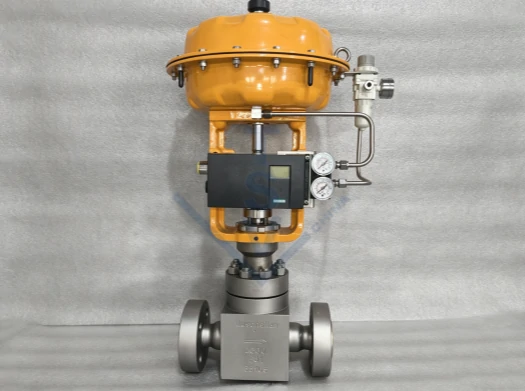
Instead of guessing, follow this sequence to identify the root cause of control valve hunting.
Look at the trend line. Is the oscillation decaying (underdamped) or sustained at a constant amplitude (limit cycle)? Decaying oscillation points to positioner or controller settings. Sustained oscillation points to mechanical friction or stiction.
Manually stroke the valve. Does it move smoothly or in jumps? If it jumps, check the packing gland. Loosen it slightly and lubricate the stem. Test again. If the hunting stops, the problem was packing friction.
If the mechanical check doesn‘t solve the problem, check the positioner gain. Reduce it and observe the response. Check the supply pressure at the positioner—it should be stable and within the manufacturer’s specified range. Perform a soap bubble test on all signal line connections.
If all mechanical and pneumatic checks are clean and the valve still hunts, the valve is likely oversized. Calculate the actual Cv requirement for your process and compare it to the valve‘s rated Cv. If the valve is operating below 20% of its rated capacity, it’s oversized and needs a trim change or replacement.
What is the difference between hunting and noise in a control valve?
Hunting is a periodic oscillation of the process variable—the flow, pressure, or temperature trend line shows a repeating wave pattern. Noise is random, high-frequency variation that doesn‘t follow a repeating pattern. Hunting affects process stability; noise is typically filtered out by the control system. If you’re seeing a steady sine wave, it‘s hunting. If you’re seeing random spikes, it‘s noise.
Can a smart positioner auto-tune to stop hunting?
Yes. Many modern smart positioners include an auto-tuning or auto-calibration function that can significantly reduce or eliminate hunting. The auto-tune routine adjusts the positioner gain, deadband, and other parameters to match the valve’s mechanical characteristics. However, auto-tuning can‘t fix mechanical problems like stiction or oversized valves—it only optimizes the pneumatic control response. If you have a smart positioner, run the auto-tune first—it’s the fastest and easiest fix.
How can I prevent hunting in a new installation?
Start with correct valve sizing. An oversized valve is the most common cause of hunting in new installations. Calculate the required Cv accurately and select a valve that operates in the 30-70% range of its rated capacity. Choose the right actuator size—under-sized actuators can’t overcome packing friction, leading to stiction and hunting. And select a positioner with adjustable gain and auto-tuning capability. TSV products can be tailor-made to reach specific constraints, so you can specify the right configuration from the start.
Control valve hunting is preventable and fixable with a systematic approach.
The foundation of stable control is correct valve sizing. Work with your valve supplier to calculate the required Cv based on your process conditions. TSV offers a full range of standard and custom valves, with over 100 series and 2,000 specifications, to match your exact requirements.
Packing friction develops over time as packing material dries out or hardens. Regular inspection and maintenance—checking packing tightness, lubricating the stem, replacing aged packing—prevents friction-related hunting before it starts. TSV provides a 12-month product warranty and lifelong free consulting services.
Smart positioners with auto-tuning capability are a worthwhile investment. They automatically compensate for minor changes in valve characteristics and can reduce hunting without manual intervention. For troubleshooting, a valve diagnostic tool that measures friction, stiction, and response time provides data that makes diagnosis faster and more accurate.
TSV Valve manufactures control valves with a strong focus on raw material integrity and quality assurance. Products range from medium to high performance, with particular emphasis on raw materials and design to adapt to customer requirements. Most products can be tailor-made to reach specific constraints, and additional services including actuating, installation, and maintenance can be provided. TSV valves are designed to meet ISO, API, ASME, ANSI, and BS standards, with rigorous quality control at multiple stages of production.
Control valve hunting doesn‘t have to be a mystery. By following a systematic diagnostic sequence—identifying the oscillation pattern, checking mechanical friction, adjusting the positioner, and verifying valve sizing—you can find and fix the root cause. Whether you’re dealing with a sticky stem, a mis-tuned positioner, or an oversized valve, the solution is within reach. TSV‘s range of control valves and technical support services can help you achieve stable, reliable process control.
Need help diagnosing control valve hunting on your process line? Reach out to TSV Valve’s technical team—they can provide remote diagnostics, maintenance guidance, and valve sizing recommendations to get your control loop stable.
Related News


E-mail: info@tsv-valve.com

Telephone: +86-13695850057

Whatsapp: +86-13695850057

Address: TianSheng Industrial Park,Dong'ou Industrial Zone,Oubei Town,Wenzhou City,Zhejiang Province,China