- Email:info@tsv-valve.com


 Jun 18,2026
You‘ve heard it before. The pump stops, and a split second later—BANG. The whole pipe shudders. Or worse, during normal operation, there’s a constant rattling, like someone shaking a coffee can full of bolts. It‘s not just annoying. It’s equipment talking to you. And what it‘s saying is: something’s wrong.
A wafer check valve that makes noise in a pump discharge line is a valve under stress. The noise isn‘t the problem—it’s the symptom. Left unaddressed, that banging or chattering will fatigue pipe supports, damage pump impellers, and eventually destroy the valve itself. This guide walks you through identifying the type of noise you‘re hearing, tracing it to the root cause, and implementing the right fix—whether that’s adjusting pump logic, changing valve size, or upgrading to a spring‑assisted design like TSV‘s lug stainless steel dual plate check valve.
Not all check valve noises are the same. The sound pattern tells you what‘s happening inside the valve—and points you to the right solution.
A single, sharp bang that occurs immediately after the pump stops. It‘s loud enough to feel through the floor. This is the sound of the valve disc slamming shut against its seat as the flow reverses. The pressure wave that follows—called water hammer—travels through the piping system and can exceed 10 times the normal operating pressure.
In a dual plate design, slam occurs when the reverse flow velocity is so high that the springs can‘t close the plates fast enough. The plates are pushed back by the forward flow, then snapped shut by the reversing flow. The faster the reverse velocity, the harder the impact.
A persistent rattling or chattering that occurs while the pump is running, not at shutdown. The valve plates are oscillating—opening and closing rapidly—rather than staying fully open. This is sometimes called “fluttering.”
Chatter happens when the flow velocity is too low to hold the plates fully open, or when the pump discharge pressure fluctuates. The plates hover near the closed position, repeatedly hitting the seat as flow pulses. Each impact is small, but the cumulative effect is rapid wear on the seat and disc.
Below is a quick reference table for noise type, sound pattern, and likely root cause:
| Noise Type | Sound Pattern | When It Occurs | Most Likely Cause |
|---|---|---|---|
| Slam | Single loud bang | At pump shutdown | High reverse flow velocity; valve closes too slowly |
| Chatter | Rapid rattling | During pump operation | Low flow; pressure fluctuation; valve oversized |
| Continuous whistle | High‑pitched tone | During operation | Foreign object stuck in seat; damaged sealing surface |
Slam is a velocity problem. The fluid in the discharge line has momentum. When the pump stops, that momentum wants to keep moving—but now in the reverse direction.
The most common cause of slam is excessive reverse flow velocity. The check valve‘s closing speed is limited by the spring force and the weight of the disc. If the reverse flow is fast enough, the disc can‘t close before the flow reverses completely. The result: the disc is slammed shut by the full force of the reversing column of liquid.
For a typical dual plate check valve, the maximum recommended reverse velocity is around 1–2 m/s. Above that, slam is almost guaranteed. The fix: reduce the pump flow rate, install a smaller valve, or upgrade to a valve with stronger springs or a dashpot mechanism that cushions closure.
Long discharge pipes store more kinetic energy. A 100‑meter pipe with water flowing at 2 m/s contains significantly more momentum than a 10‑meter pipe. When the pump stops, all that energy has to go somewhere—and it goes into slamming the check valve closed.
If pipe length can‘t be reduced, the solution is a valve that closes faster. Spring‑assisted dual plate check valves like TSV‘s lug stainless steel design close more quickly than gravity‑operated swing checks, reducing the reverse flow velocity at the moment of closure.
Chatter is a flow problem. The valve isn‘t getting enough flow to stay fully open, or the flow is unstable.
Every check valve has a minimum flow requirement—the flow rate needed to hold the disc fully open. For a dual plate check valve, this is typically around 20‑30% of the valve‘s rated capacity. If the system operates below that threshold, the plates won‘t open fully. They‘ll hover near the seat, bouncing as flow pulses.
The fix: install a smaller valve (to match the actual flow), or add a recirculation line that bypasses the valve to maintain minimum flow through the system.
Pumps that start and stop frequently—or that cycle on and off under automatic control—create pressure pulses that cause the check valve plates to flutter. Each startup and shutdown is a mini‑event that stresses the valve.
The fix: review the pump start/stop logic with your automation team. Adjust setpoints to reduce short‑cycling, or add a variable frequency drive (VFD) that ramps the pump up and down smoothly rather than starting and stopping abruptly.
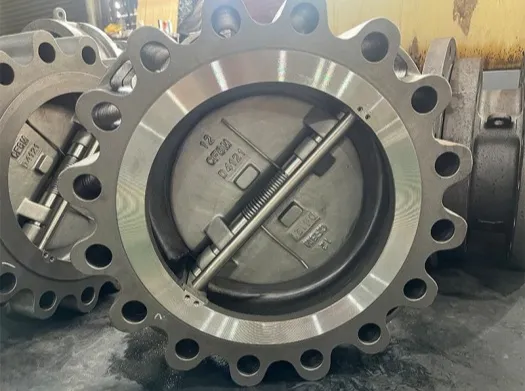
Before you order a replacement valve or call a technician, run through this inspection. It takes 20 minutes and catches most mechanical issues.
For spring‑assisted valves, inspect the torsion springs. They should be intact and under tension. A broken spring allows the plate to flutter, causing chatter. If a spring is broken, replace it. On TSV‘s dual plate check valve, the springs are heavy‑duty stainless steel, designed for long service life—but even the best springs can fatigue over time.
With the valve isolated and drained, manually move the disc or plates through their full range of motion. They should move smoothly, with no binding or scraping. Look for wear marks on the disc edges and the seat. Excessive wear indicates the valve has been operating outside its design parameters—too much chatter, too much slam, or both.
Debris—welding slag, pipe scale, or sediment—can get caught between the disc and the seat. This prevents the valve from sealing fully, causing leakage and, in some cases, noise. Clean the sealing surfaces with a soft cloth and inspect for pitting or scoring. If the seat is damaged, the valve may need resurfacing or replacement.
Q: Can a spring‑assisted wafer check valve reduce slamming?
A: Yes—and this is one of the primary reasons to specify a spring‑assisted design. The torsion springs in a dual plate check valve begin closing the plates as soon as forward flow decreases, before reverse flow can develop. This reduces the reverse flow velocity at the moment of closure, minimizing slam. TSV‘s lug stainless steel dual plate check valve uses heavy‑duty stainless steel torsion springs for fast, stable closure in demanding pump discharge applications.
Q: What’s the difference between a silent check valve and a wafer check valve?
A: A silent check valve (also called a nozzle check valve) uses a spring‑loaded disc that moves axially—like a piston—rather than pivoting on a hinge. It closes faster and with less noise than a traditional swing check, but it has higher pressure drop and is more expensive. A wafer check valve, by contrast, is compact, lightweight, and cost‑effective. The dual plate design offers a good balance: fast closure (reducing slam) with low pressure drop and a compact footprint that fits between flanges.
Q: Does pipe diameter affect check valve noise?
A: Yes—indirectly. The pipe diameter determines the flow velocity for a given flow rate. A valve that‘s oversized for the actual flow will operate at low velocity, which can cause chatter. A valve that‘s undersized will operate at high velocity, increasing the risk of slam. The key is matching the valve size to the actual flow conditions. For a given flow rate, a smaller valve means higher velocity—which can cause slam—while a larger valve means lower velocity—which can cause chatter. Always size check valves based on actual operating flow, not pipe diameter alone.
Not every noisy check valve can be fixed with adjustments. Sometimes replacement is the more cost‑effective answer.
If the disc or seat is worn beyond 20% of its original thickness, repairs won‘t restore the valve to reliable operation. The sealing surface has lost its integrity—the valve will leak, and the noise will return. Replacement is the only lasting solution.
Wafer check valves in corrosive environments—saltwater, chemical processing, wastewater—can suffer body corrosion that compromises structural integrity. If the body shows pitting, scaling, or visible thinning, replace the valve. A corroded body is a failure waiting to happen.
Add up the cost of replacement parts, labor, and downtime. If it‘s more than 60‑70% of the cost of a new valve, replace it. A new TSV lug stainless steel dual plate check valve comes with fresh springs, clean sealing surfaces, and a full warranty—and it eliminates the risk that a repaired valve will fail again in six months.
The compact wafer body fits seamlessly between standard flanges, offering significant space and weight savings compared to traditional swing check valves. This makes installation easier and reduces overall system load.
The lug-type body design provides additional advantages for pump discharge systems: bolts can pass directly through the lug holes, allowing for more secure mounting than a standard wafer design. This is particularly beneficial in applications subject to vibration, or where one side of the piping may need to be isolated for maintenance without affecting the other side.
TSV is committed to quality at every stage of production. Each valve undergoes rigorous in-process inspections, and the company holds key certifications including ISO, API, ASME, ANSI, and BS. Raw materials are carefully selected, and designs can be adapted to meet specific customer requirements. With over 100 series and 2,000 specifications, TSV offers a wide range of options to suit diverse flow conditions.
Before replacing a noisy check valve, it's important to verify your actual specifications: the size, class, material of body&trim and end connection. By sharing these details with TSV, our engineering team can recommend the right valvem tailored to your specific application.
If you are experiencing noise issues with a wafer check valve in your pump discharge line, contact TSV for a consultation or to request a valve selection guide. Our technical team will recommend the optimal lug-type stainless steel dual plate check valve configuration for your system.
Related News



E-mail: info@tsv-valve.com

Telephone: +86-13695850057

Whatsapp: +86-13695850057

Address: TianSheng Industrial Park,Dong'ou Industrial Zone,Oubei Town,Wenzhou City,Zhejiang Province,China