- Email:info@tsv-valve.com


 Apr 07,2026
Anti-static design, suspended solids handling, and in-house API/CE certified testing. A practical B2B guide for engineers and procurement teams.
A quarter-turn valve looks simple. Turn the handle 90°, flow starts or stops. But when your media contains suspended solids or static builds up with each cycle, simple isn't enough.
For chemical plants, oil and gas, or slurry applications, you need a device that handles corrosion, resists static discharge, and keeps working with particles in the flow.
A quarter-turn shut-off device opens or closes with a 90° stem rotation. You can run it manually or with an actuator — pneumatic, electric, or hydraulic — depending on pressure and bore size. It's a switching device, not a control valve. You don't keep it partially open during normal operation.
So far, nothing special. The difference shows up when conditions get rough.
Standard components fail fast with flammable gases, abrasive slurries, or corrosive chemicals. Here's what separates industrial-grade units from basic ones.
Every time the ball rotates, friction creates static electricity. In petrochemical, gas, or solvent handling lines, that static is a real ignition risk. A proper shut-off valve must have a way to dissipate that charge safely. No spark, no worry.
When the line is pressurized, cheap valves become hard to turn. A thrust bearing reduces friction torque. That means you can operate the valve by hand even under pressure. For actuated systems, lower torque means less wear on gears and motors.
Many quarter-turn valves struggle when the media carries solid particles. Particles get trapped, scratch the ball, or block the seat. A well-designed unit keeps working without frequent jamming. The construction — ball, stem, cover, two‑body design — matters.
Not just the body — the ball, stem, and seats too. The right material selection based on your media means fewer unexpected replacements.
Even in reduced bore designs, a good valve creates minimal flow restriction. Your pump works less hard. Energy cost drops.
Now let's look at a company that actually builds all of the above — not just claims them.
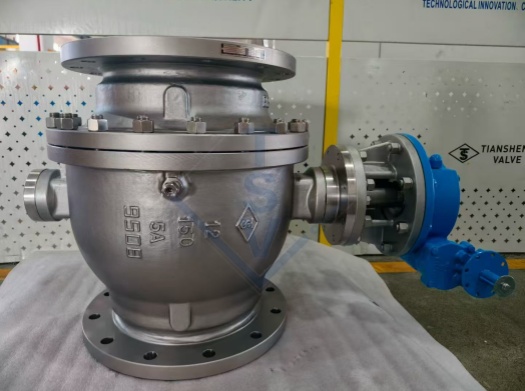
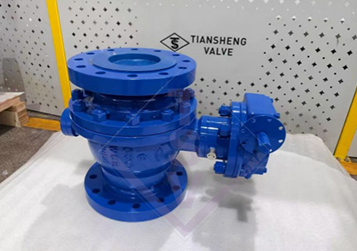
TSV offers a high-performance series of rotary isolation valves. Their line includes floating, trunnion, 3‑way, metal‑to‑metal seat, and reduced bore types. They are API and CE certified, with an API6D product line that includes ball valves . All critical testing is done in-house.
| Feature / Capability | Detail |
|---|---|
| Anti-static function | Dissipates static charge safely during switching |
| Thrust bearing | Low torque operation even under line pressure |
| Suspended solids handling | Designed for media with solid particles — resists jamming |
| Corrosion resistance | Body, ball, stem, seats — materials matched to your media |
| Low fluid resistance | Minimal pressure drop, full bore and reduced bore |
| Tailor-made capability | Pressure rating, temperature, end connections, materials, actuation type |
| In-house testing | Chemical analysis, mechanical, NDT (UT/MT/PT/RT), PMI, high-pressure air, cryogenic, high-temp, fugitive emission |
| Certifications | API, CE, ISO 9001:2008 |
| Support | Actuating (pneumatic/electric/hydraulic), installation, maintenance, test reports on request |
Choosing a ball valve for harsh conditions means ensuring static safety, low torque, and solid-handling ability.
Anti-static — critical for flammable environments
Thrust bearing — smooth operation under pressure
Handles suspended solids — fewer jams, longer life
In-house NDT, PMI, cryogenic, fugitive emission testing
API, CE, ISO 9001
Custom and actuation services available
Deciding between floating vs. trunnion? Worried about static or solids? Contact TSV to discuss your pressure, temperature, media (especially with particles), and any special testing requirements.
Previous: NULL
Related News


E-mail: info@tsv-valve.com

Telephone: +86-13695850057

Whatsapp: +86-13695850057

Address: TianSheng Industrial Park,Dong'ou Industrial Zone,Oubei Town,Wenzhou City,Zhejiang Province,China