- Email:info@tsv-valve.com


 Apr 29,2026
A butterfly valve operates around a rotating disc. When the lever is turned 90°, the disc rotates from parallel to the flow (open) to perpendicular (closed). Unlike a gate valve that lifts a wedge out of the flow path, a butterfly valve keeps the disc in the bore even when fully open, creating a residual pressure drop.
This design has three practical consequences. First, the valve is compact and lightweight: the face‑to‑face dimension of a flanged butterfly valve is typically 50‑75mm for common sizes—about one‑fifth the length of an equivalent gate valve. Second, the 90° operation enables rapid open/close cycling, ideal for frequent operation. Third, because the disc remains in the flow stream, the valve is not intended for extended throttling, but performs very well for on‑off isolation.
Zero‑offset butterfly valves (resilient‑seated type) have the stem, disc, and body concentrically aligned. This is the simplest construction and the most common for manual lever operation, because the low seating torque allows a standard lever to generate enough closing force without a gearbox.
The product name specifies Lever Operated. A lever‑operated butterfly valves relies on the operator's manual force to rotate the disc against the resilient seat. For an optimized disc design, the required operating force can be reduced by up to 30% compared to basic designs.
In the field, a lever that won't reach the fully closed detent usually indicates one of three problems:
The resilient seat has swollen from chemical incompatibility (EPDM swells in oils; NBR degrades in ozone)
Debris has lodged between the disc edge and the seat
The lever stop mechanism is misaligned from an over‑torque event
TSV designs its lever stops to withstand 450 ft‑lbs of input torque, exceeding what most operators can manually apply.
The lever handle includes integrated locking holes to secure the valve in either fully open or fully closed position using a padlock. For isolation valves on lines where accidental operation could create a safety hazard, this locking feature is not optional.
The ductile iron body serves a specific purpose. Unlike gray cast iron, which is brittle, ductile iron (nodular cast iron) has a minimum tensile strength of 60,000 psi and retains impact resistance down to sub‑freezing temperatures.
A lever‑operated ductile iron butterfly valves designed for 125/150 lb flanges typically has a maximum working pressure around 200 psi (1.6 MPa). The disc is often aluminum‑bronze or 316SS, with a resilient seat—usually EPDM, NBR, or Viton.
TSV's butterfly valve range supports multiple pressure classes: ANSI 150#, PN10, and PN16. The flanged variant includes extended rims for bolting between two pipeline segments, making it suitable for dead‑end service.
The body may be ductile iron, but the seat limits the temperature range.
| Seat Material | Typical Temperature Range | Chemical Resistance |
|---|---|---|
| EPDM | -45°C to 130°C | Water, wastewater, dilute acids |
| NBR | -30°C to 90°C | Oil, fuel, hydrocarbons |
| Viton | -20°C to 180°C (peak 200°C) | Aggressive chemicals, acids, steam |
EPDM is the default for water and wastewater service. Viton should be specified for temperatures above 130°C or chemical applications.
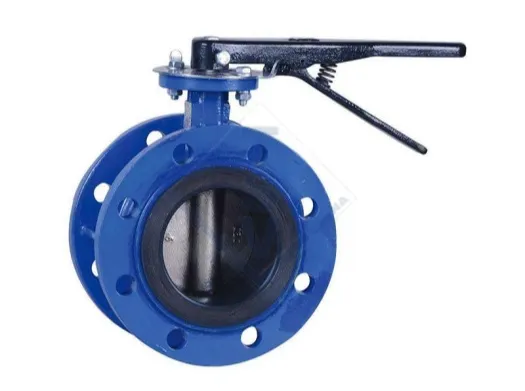
The product name includes Flange connection. Flanged butterfly valves are typically produced in larger dimensions (4″ and above) and support multiple pipe flange standards: ASME B16.5, EN 1092, and GB/T 9113.
A wafer‑style butterfly valve is clamped between two flanges; removing downstream pipework unloads the clamping force and the valve can fall apart. A lug‑style valve has threaded inserts and can be dead‑ended. A flanged valve has integral flanges on both ends and is the most robust option for pipelines that require frequent disassembly or where the valve serves as an isolation point.
A butterfly valves assembly with a lever is the right choice for:
Large diameters (4″ to 48″) where the cost of a gate valve would be excessive
Frequent operation (multiple cycles per shift) where the 90° quarter turn saves time
Weight‑sensitive installations (e.g., elevated pipe racks) where a butterfly valve weighs 60‑80% less than an equivalent gate valve
Bubble‑tight shut‑off at low to moderate pressure (up to 200 psi) using a resilient seat
Butterfly valves typically cost 60‑75% less than equivalent gate valves. The face‑to‑face length of a wafer butterfly valve is roughly 50‑75mm for common sizes; an equivalent gate valve might be 300‑400mm. For a pipe rack with limited real estate, that space saving alone can justify the valve type selection.
TSV's butterfly valve platform includes selectable sealing technologies—from elastomeric resilient seats to metal‑to‑metal variants including triple‑offset designs—allowing performance‑matched selection based on the fluid media and service conditions.
For pipe diameters above 8″ or working pressures above 150 psi, the torque required to rotate the disc against differential pressure becomes too high for a standard lever. Gear‑operated valves use a reduction gear (typical ratio 50:1) that multiplies manual input torque while requiring many turns of the handwheel. Rule of thumb: if the lever requires significant body weight to close, specify a gear operator.
Before installing a new butterfly valves into a live line, run these three tests on a sample valve.
Rotate the lever slowly from fully open to fully closed. Both end positions should have a positive detent stop—you should feel a click when the disc reaches full closure. If the lever stops before the detent or passes through without engagement, the stop mechanism is misaligned.
Close the valve and apply low‑pressure air (5‑10 psi) to the upstream side while submerging the downstream side in water. Zero bubbles for 30 seconds confirms that the resilient seat is compressing evenly around the full disc circumference.
Place the valve between two flanges without bolts. The flange faces should lie flush against the mating flanges. Any gap larger than 0.5mm indicates a warped flange face—installation will overstress bolts and may crack the ductile iron body.
TSV manufactures butterfly valves across zero‑offset, double‑offset, and triple‑offset designs, with body configurations including wafer, lug, flanged, and welded types. The Ductile Iron Flange Lever Operated Butterfly Valve represents the resilient‑seated, zero‑offset segment—economical, lightweight, and suitable for water, wastewater, air, and light chemical service.
For higher temperature or aggressive media, TSV offers valves with metal‑to‑metal seating and advanced coatings such as HVOF thermal spraying (layer thickness up to 350 microns), exceeding typical industry specifications.
TSV maintains certifications across ISO, API, ASME, ANSI, BS, and NF standards. Each valve undergoes shell testing at 1.5 times design pressure and bubble‑tight seal verification at 1.1 times design pressure before shipment, per API standards.
A butterfly valves system with a lever costs less, weighs less, and takes up less space than a gate valve. But it should not be specified for high‑temperature steam, abrasive slurries, or continuous throttling service.
For water lines, HVAC systems, air compressor outlets, and wastewater isolation—where the valve cycles multiple times per shift and bubble‑tight shut‑off at low pressure is required—the Ductile Iron Flange Lever Operated Butterfly Valve from TSV is a proven solution.
Related News



E-mail: info@tsv-valve.com

Telephone: +86-13695850057

Whatsapp: +86-13695850057

Address: TianSheng Industrial Park,Dong'ou Industrial Zone,Oubei Town,Wenzhou City,Zhejiang Province,China