- Email:info@tsv-valve.com


 Sep 09,2026
You're specifying valves for a high-temperature, high-pressure pipeline, and the word "butterfly" might not be the first thing that comes to mind. Traditional butterfly valves have a reputation for leakage and limited temperature range. But a butterfly valve with a triple-offset design and metal-to-metal sealing changes that entirely. The API Three Eccentric Worm Gear Driven Butt-Welded Butterfly Valve was engineered to deliver bubble-tight zero leakage even under extreme conditions—up to 550°C and beyond. This article walks through what makes the triple-offset design fundamentally different from standard butterfly valves, why metal-to-metal sealing matters for high-temperature applications, and how butt-welded connections and worm gear operation contribute to long-term reliability in critical service.
Q: What does "triple offset" actually mean, and why does it matter?
A: The triple-offset design eliminates friction between the disc and seat during operation. This means the sealing surfaces don't wear against each other as the valve opens and closes—resulting in a tight, bubble-tight seal, zero leakage, and significantly extended service life.
Q: What temperature and pressure range can this valve handle?
A: The valve operates across a temperature range of -46°C to 550°C, with different material options for different working conditions. It's designed for high-pressure applications across oil and gas, power generation, and chemical processing.
Standard butterfly valves use a concentric design where the disc rotates through the seat, creating friction with every cycle. Over time, that friction wears the sealing surfaces, and leakage begins. The triple-offset design adds three geometric offsets that move the disc out of the seat's path during rotation. The disc only contacts the seat at the fully closed position. No friction means no wear. No wear means zero leakage—even after thousands of cycles. This is the fundamental engineering insight that transforms a butterfly valve from a low-performance commodity into a high-performance solution for critical applications.
The first offset moves the shaft behind the disc sealing plane. The second offset moves the shaft to one side of the pipe centerline. The third offset creates a conical sealing geometry. Together, these three offsets create a cam-like action that lifts the disc clear of the seat during rotation. The result is a valve that seals like a gate valve but operates with the quarter-turn simplicity of a butterfly valve.
By eliminating friction between the disc and seat during operation, the triple-eccentric design minimizes wear on the sealing surfaces, extending the valve's service life and reducing maintenance costs. For operators managing critical pipelines, this translates to fewer shutdowns and lower total cost of ownership.
Elastomeric seats work well at moderate temperatures but fail when things get hot. They soften, deform, and lose their sealing capability. Metal-to-metal sealing, by contrast, maintains its integrity at temperatures where elastomers would melt. The metal seat provides excellent performance in extreme temperatures and pressures. It's highly resistant to corrosion, erosion, and wear—ensuring long-term reliability in harsh environments. For applications in power generation, refining, and chemical processing where temperatures regularly exceed 200°C, metal-to-metal sealing isn't optional—it's essential.
The valve is designed for operating temperatures from -46°C to 550°C, with different raw materials for different working temperature requirements. This range covers everything from cryogenic service to high-temperature steam applications—making it one of the most versatile butterfly valve designs on the market.
The combination of triple-offset geometry and metal-to-metal sealing ensures a bubble-tight seal, even under extreme conditions. For critical applications where leakage is not an option—such as toxic or flammable media—this level of sealing performance provides the confidence that operators need.
Flanged connections have gaskets that can fail. Threaded connections have potential leak paths. Butt-welded connections eliminate both issues by creating a permanent, metallurgical joint between the valve and the pipe. The butt-welded end connection ensures a strong, permanent, and leak-proof joint, ideal for high-pressure piping systems. It provides superior strength and stability, making it suitable for high-stress applications. For pipelines that operate at high pressure or carry hazardous media, the butt-welded connection isn't just a preference—it's a safety requirement.
The welded joint becomes part of the pipe system, sharing the same strength characteristics as the pipe itself. This eliminates the weak points that flanged connections introduce and provides the structural integrity that high-stress applications demand.
The valve features a flangeless design, which makes the pipeline installation elegant and convenient. Without flanges, you save space and weight while eliminating potential leak paths.
Manual operation of a large-diameter, high-pressure butterfly valve requires significant torque. The worm gear operator provides the mechanical advantage needed for smooth, precise operation. The worm gear mechanism allows for smooth and precise operation, enabling accurate positioning of the valve disc. The gear-driven design provides high torque output, making it easier to operate the valve in high-pressure or large-diameter applications. The worm gear also has a self-locking feature—the valve stays in position without needing a brake or locking mechanism.
Beyond simple on-off service, the worm gear operator provides the fine control needed for flow regulation. Accurate positioning of the valve disc means you can modulate flow with precision—making the valve suitable for throttling applications as well as isolation service.
Despite its heavy-duty capabilities, the valve features compact configuration, tiny bulk, and light weight—operating skillfully and conveniently. This makes installation and maintenance easier than comparable valves with similar pressure and temperature ratings.
| Parameter | Specification |
|---|---|
| Design Standard | API 609 |
| Face-to-Face Dimension | ISO 5752 Series 14 |
| Pressure-Temperature Rating | ASME B16.34 |
| Welding End Size | ASME B16.25 |
| Inspection and Test | API 598 |
| Temperature Range | -46°C to 550°C |
| Seat Type | Metal-to-Metal |
| Design Feature | Triple Eccentric (Three Offset) |
| Leakage Rating | Zero / Bubble-Tight |
| Connection Type | Butt-Welded (No Flange) |
| Operator Type | Worm Gear Driven |
| Flow Direction | Bidirectional |
| Key Applications | Oil & Gas, Power Generation, Chemical Processing |
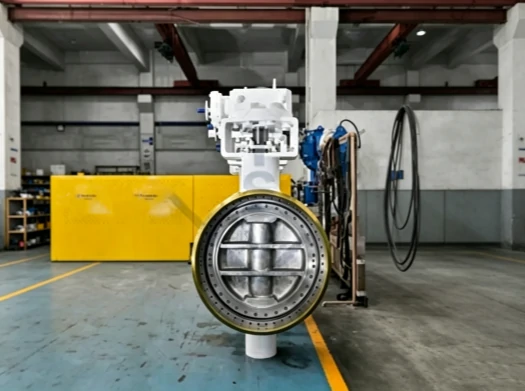
The valve is designed and manufactured in compliance with API 609 standards, ensuring high-quality performance and reliability for industrial applications. API 609 is the industry standard for butterfly valves, covering design, materials, testing, and inspection requirements. Compliance means the valve meets the rigorous performance criteria that oil and gas, power generation, and chemical processors expect.
Meeting international standards ensures compatibility with existing systems and components. When you specify an API-compliant valve, you know it will interface correctly with standard piping, actuators, and instrumentation.
The valve is designed to handle bidirectional flow and pressure, making it suitable for applications where flow direction may change. This versatility simplifies piping design and reduces the risk of installation errors.
The API three eccentric butterfly valve serves critical applications across multiple industries:
High-pressure, high-temperature pipelines in upstream and midstream oil and gas operations demand zero-leakage performance. The valve's metal-to-metal sealing and butt-welded connections provide the reliability that these critical systems require.
Steam systems, cooling water circuits, and fuel gas lines in power plants operate at extreme temperatures and pressures. The valve's -46°C to 550°C range covers the full spectrum of power generation applications.
Corrosive media, high temperatures, and demanding cycle requirements make chemical processing a natural fit for triple-offset butterfly valves. The metal seal's resistance to corrosion, erosion, and wear ensures long-term reliability in harsh chemical environments.
The valve is suitable for pipes requiring high temperature resistance, fire-proof performance, and jacketed heating applications—where standard butterfly valves simply cannot operate.
Q: What's the difference between a triple-offset butterfly valve and a standard butterfly valve?
A: A standard butterfly valve has a concentric design where the disc rubs against the seat during operation, causing wear and eventual leakage. A triple-offset valve uses three geometric offsets that eliminate friction between the disc and seat, delivering zero leakage and much longer service life.
Q: Why choose metal-to-metal sealing over soft seating?
A: Metal-to-metal sealing handles much higher temperatures than elastomeric seats—up to 550°C versus typically 200°C for soft-seated valves. It's also more resistant to corrosion, erosion, and wear, making it suitable for harsh industrial environments.
Q: What does "butt-welded" mean for installation and maintenance?
A: Butt-welded connections are welded directly to the pipe, creating a permanent, leak-proof joint. This eliminates the gaskets and bolted joints that can leak on flanged connections. However, it also means the valve is permanently installed—removal requires cutting the weld.
Q: Does this valve handle bidirectional flow?
A: Yes. The valve is designed to handle bidirectional flow and pressure, making it suitable for applications where flow direction may change.
A butterfly valve that delivers zero leakage, handles temperatures from -46°C to 550°C, and provides bubble-tight sealing through a triple-offset metal-to-metal design is the practical choice for critical applications where standard valves fail. The API Three Eccentric Worm Gear Driven Butt-Welded Butterfly Valve delivers triple-offset design that eliminates friction and extends service life, metal-to-metal sealing for high-temperature and high-pressure resistance, butt-welded connections for permanent, leak-proof installation, worm gear operation for precise control and mechanical advantage, API 609 compliance for industry-standard quality and interchangeability, and bidirectional sealing capability for versatile installation.
Whether you're specifying valves for oil and gas pipelines, power generation steam systems, chemical processing plants, or high-temperature industrial services, this valve offers the durability, precision, and reliability that demanding applications require. With compact configuration, lightweight design, and a flangeless butt-welded connection, it's built for performance where it matters most.
Contact TSV for a triple-offset butterfly valve configuration assessment → their team can help you select the right materials, size, and operator options for your specific pressure, temperature, and media requirements. Get a valve that delivers zero leakage—even when the conditions are anything but ordinary.
Related News


E-mail: info@tsv-valve.com

Telephone: +86-13695850057

Whatsapp: +86-13695850057

Address: TianSheng Industrial Park,Dong'ou Industrial Zone,Oubei Town,Wenzhou City,Zhejiang Province,China