- Email:info@tsv-valve.com


 Nov 04,2026
Yes—when the ball is anchored at top and bottom and driven by a spring-return pneumatic actuator, a Trunnion Ball Valve in ESDV service can close in ≤2 seconds even at ASME Class 1500 pressure. That speed is what makes it suitable for emergency shutdown duty, where a floating ball design would bind under high differential pressure. This article explains how the trunnion arrangement delivers low torque and stable sealing, what the fail-close actuator contributes to rapid isolation, and what to verify when you're specifying an ESDV for a high-pressure pipeline.
In a floating ball valve, the ball is held against the seat by line pressure. As the pressure rises, the force pushing the ball into the seat increases, and the torque required to rotate the ball rises with it. In a large valve, that torque can exceed what a pneumatic actuator can deliver reliably.
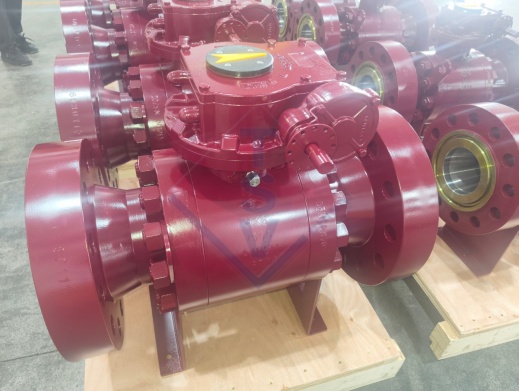
A trunnion-mounted ball is captured by upper and lower stem supports. The ball rotates on its axis without being pushed downstream by the pressure. The seat rings move independently to maintain contact with the ball surface. The result is a 30–50% reduction in operating torque compared with a floating ball design, which allows a smaller actuator and a faster stroke.
The trunnion support keeps the ball centered in the body bore. The seat rings are free to float against the ball, so the sealing contact stays uniform even when the pressure differential across the valve is high. That stability is what allows the ESDV to hold a bubble-tight shutoff after the emergency closure, rather than leaking through a seat that has been distorted by pressure.
| Parameter | ESDV Trunnion Ball Valve Specification |
|---|---|
| Valve type | ESDV (Emergency Shutdown Valve) |
| Configuration | Trunnion-mounted ball valve |
| Nominal size | 6" (DN150) |
| Pressure class | ASME Class 1500 |
| Body material | ASTM A350 LF2 (low-temp carbon steel) |
| Ball type | Trunnion mounted |
| End connection | Flanged, RTJ (Ring Type Joint) |
| Actuation | Pneumatic actuator |
| Design standard | API 6D / ASME B16.34 |
| Fire safe | API 607 / API 6FA |
| Face-to-face | ASME B16.10 |
| Flange standard | ASME B16.5 |
| Temperature range | -29°C to +120°C |
| Application | Emergency shutdown / critical isolation |
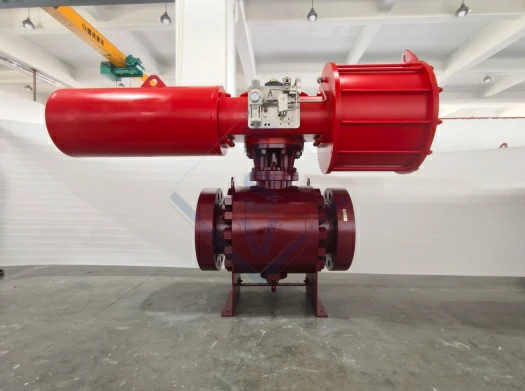
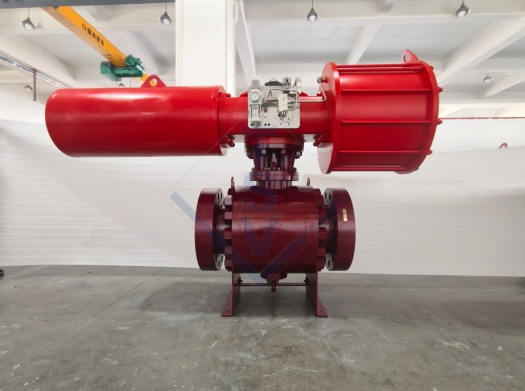
An ESDV is not a normal control valve. It sits open for months at a time, waiting for a signal that may never come. When that signal does arrive—overpressure, leak detection, fire, or a manual E-stop—the valve has to close without hesitation. The fail-close design means the actuator drives the valve to the closed position when the signal or the power supply is lost.
The TSV ESDV uses a pneumatic actuator with a spring-return mechanism. Under normal operation, air pressure holds the spring compressed and the valve open. When the safety system vents the air, the spring drives the valve closed. That spring is the final safeguard—it doesn't depend on electricity, instrument air, or a control signal to function.
The closure time is ≤2 seconds for full-bore shutoff. That speed is critical in a pipeline emergency, where a delay of a few seconds can allow a pressure wave to propagate or a leak to escalate.
API 607 and API 6FA are the fire-test standards for quarter-turn valves. The test simulates a fire condition by burning the valve at high temperature for a specified period, then cooling it and checking whether the valve still seals. A valve that passes retains a secondary metal-to-metal seal that survives even after the soft seat material has been consumed by the fire.
The ESDV's fire-safe design includes that secondary seal. In a fire event, the primary soft seat may degrade, but the metal backup maintains the isolation function until the fire is extinguished or the pipeline is depressurized. For a valve installed near a process unit or a storage tank, that certification is not optional—it's the difference between a contained incident and a catastrophic release.
A Trunnion Ball Valve in ESDV service is installed at pipeline section boundaries, terminal inlet/outlet points, and critical isolation locations in oil and gas, petrochemical, and LNG facilities. The valve acts as the final barrier between a hazardous process section and the surrounding equipment or environment.
The forged ASTM A350 LF2 body is selected for low-temperature service down to -29°C. The RTJ flanged connections provide a metal-to-metal seal at the flange face, which is more resistant to vibration and thermal cycling than a raised-face gasket. Those features suit the high-pressure, high-integrity joints used in Class 1500 piping systems.
The ESDV is rated ASME Class 1500, which corresponds to a cold working pressure of approximately 250 bar (depending on material and temperature). Check the maximum operating pressure of the pipeline against the class rating, and confirm that the flange rating at the installation point matches the valve's Class 1500 flanges.
The standard actuation is pneumatic with a spring-return fail-close mechanism. If the facility uses hydraulic or electro-hydraulic actuation, confirm whether the ESDV can be supplied with an alternative actuator. The actuator must interface with the plant's safety instrumented system (SIS) and meet the required SIL level for the loop.
Inspect the seat rings for wear and the ball surface for scratches or deposits during scheduled maintenance. The trunnion bearings should be checked for smooth rotation. Verify the fire-safe secondary seal is intact, and test the actuator's closure time against the ≤2 second specification. A partial stroke test can confirm the valve's readiness without interrupting the process.
A floating ball valve supports the ball only by the seats, and line pressure pushes the ball into the downstream seat. A trunnion ball valve anchors the ball at the top and bottom, so the ball rotates on fixed bearings and the seats float independently. The trunnion design reduces torque and maintains sealing under high pressure.
The standard ESDV is rated for -29°C to +120°C. Cryogenic service (down to -196°C for LNG) requires a different body material, extended bonnet, and cryogenic testing. The standard LF2 carbon steel body is not suitable for cryogenic temperatures.
Bubble-tight shutoff is a seat leakage standard—typically API 598 or ANSI Class VI—that specifies zero visible leakage when the valve is tested with air or gas under water. A valve that meets this standard seals completely, with no bubbles escaping past the seat.
The testing interval depends on the plant's safety integrity level (SIL) verification and the applicable codes. Many facilities perform a partial stroke test quarterly or semi-annually to confirm the valve moves freely, and a full stroke test during major turnarounds. The actuator and the safety system response should be tested at the same interval.
A Trunnion Ball Valve for ESD service should match the pipeline pressure class, valve size, and safety system interface—not the other way around. The ESDV Trunnion Ball Valve from TSV uses a forged ASTM A350 LF2 body in 6" (DN150) at ASME Class 1500, with RTJ flanged ends, a pneumatic fail-close actuator, ≤2 second closure time, and API 607/API 6FA fire-safe certification. If you're specifying emergency isolation for an oil and gas, petrochemical, or pipeline application, send us your pressure class, size, and actuation requirement — we'll help you confirm the right configuration before you order.
Previous: NULL
Related News


E-mail: info@tsv-valve.com

Telephone: +86-13695850057

Whatsapp: +86-13695850057

Address: TianSheng Industrial Park,Dong'ou Industrial Zone,Oubei Town,Wenzhou City,Zhejiang Province,China