- Email:info@tsv-valve.com


 Oct 21,2026
You're standing next to a pump station, and the pump shuts down—the check valve slams shut, the pipe jumps, and a bang echoes through the building. That's water hammer, the pressure surge created when a moving column of water is stopped abruptly. A Control Valves device like the 700X pump control valve prevents that surge by closing in two stages instead of one. This article explains how the staged closure works, what the solenoid pilot system contributes, and what to verify when you're selecting a pump control valve for a water supply or industrial system.
A standard check valve closes when flow reverses. When the pump stops, the downstream water column continues moving forward for a moment, then reverses and slams the check valve shut. That sudden stop converts the kinetic energy of the water column into a pressure spike, which travels back through the pipe as a shock wave.
The pressure spike can be several times the normal operating pressure. It stresses pipe joints, valve bodies, and pump casings. Over time, that stress causes fatigue cracks, gasket failures, and premature equipment replacement. In high-rise buildings with long vertical risers, the surge is amplified by the height of the water column.
The 700X doesn't wait for reverse flow to close. It begins closing before the pump stops, using the inlet pressure to drive the main valve toward the closed position. By the time the pump actually stops, the valve is already 90% closed. The remaining 10% closes against the small residual flow, and the pressure surge is a fraction of what a sudden check-valve closure would produce.
That two-stage closure is the core function of the valve. It converts one abrupt stop into two controlled movements, each with much lower energy.
When the pump is running and supplying water downstream, the solenoid pilot valve is fully open. The needle valve is adjusted to a suitable opening, and upstream water flows through the needle valve and check valve into the main valve control room, then out through the solenoid pilot valve. The pressure in the control room holds the main valve at the appropriate opening, maintaining normal downstream supply.
When the pump is about to stop, the solenoid pilot valve closes. The control room stops draining, the pressure in the control room rises, and the main valve begins to close. When it reaches about 90% closed, a limit switch on top of the main valve outputs the pump-stop signal, and the pump stops running.
With the pump stopped and the valve 90% closed, the downstream water column is still moving slightly. That return water enters the main valve control room through a check valve, raising the control-room pressure further and driving the main valve to full closure. The final 10% closes against a much smaller flow and a much smaller pressure differential, so the surge is minimal.
The result is a complete seal against reverse flow, with the water hammer energy dissipated across two controlled stages instead of one abrupt slam.
| Parameter | 700X Pump Control Valve |
|---|---|
| Nominal diameter | DN20–DN600 |
| Nominal pressure | 1.0, 1.6, 2.5 MPa |
| Working temperature | 0°C–80°C |
| Fluid medium | Water |
| Control voltage | 220V AC or 24V DC |
| Closure sequence | 90% before pump stop, 10% after |
| Limit switch | Outputs pump-stop signal at 90% closure |
| Body material | Carbon steel, stainless steel, or ductile iron |
| Connection | Flanged |
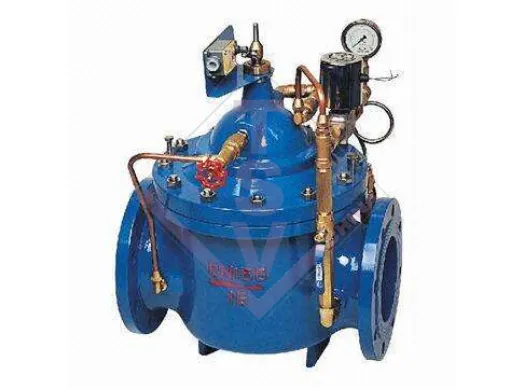
The 700X operates automatically in response to pump activity. The solenoid pilot valve is the interface between the electrical control system and the hydraulic valve. When the pump control circuit energizes the solenoid, the pilot valve opens and the main valve opens. When the circuit de-energizes the solenoid, the pilot valve closes and the main valve begins its staged closure.
The operator doesn't have to watch the pump and manually close a valve. The valve responds to the same signal that starts and stops the pump, so the closure sequence is synchronized with the pump's own operating cycle. The control voltage can be 220V AC or 24V DC, matching the available control power in the pump station.
The needle valve in the pilot circuit adjusts the opening degree of the main valve. By setting the needle valve, the operator controls how fast the main valve opens and how the control-room pressure responds. That adjustment matters when the pump has a specific start-up ramp or when the downstream system needs a controlled fill rate.
The main valve body is streamlined, and the solenoid pilot provides accurate opening and closing. The combination of the streamlined body and the pilot control keeps the flow path efficient and the closure precise.
The 700X is installed at the pump outlet in high-rise building water supply systems, municipal water networks, irrigation systems, and industrial fluid handling. The common thread is a pump that starts and stops on a regular schedule, with a downstream pipe network that's sensitive to pressure surges.
In a high-rise building, the pump lifts water to a rooftop tank or a pressure vessel. The vertical riser amplifies water hammer, so the two-stage closure is particularly valuable. In a municipal booster station, the valve protects the distribution main from surges when the booster pump cycles. In irrigation, the valve prevents backflow and surge damage when the pump is switched off at the end of a watering cycle.
The valve is suitable for clean water, wastewater, and other fluid systems. The body materials—carbon steel, stainless steel, or ductile iron—cover the corrosion resistance requirements of different water qualities. The operating temperature range of 0°C to 80°C covers the water temperatures in municipal and building services.
A Control Valves solution like the 700X from TSV combines the two-stage closure, solenoid pilot operation, and DN20–DN600 size range in a single pump-protection package. The valve is designed to be installed with minimal maintenance and to provide reliable performance across a range of operating conditions.
Match the nominal diameter to the pump discharge line size. The 700X covers DN20 to DN600, which spans small booster pumps through large municipal units. A valve that's undersized creates a pressure drop; one that's oversized may not respond smoothly at low flows. Use the pump's rated flow and the line velocity to confirm the size.
The 700X is available in 1.0, 1.6, and 2.5 MPa ratings. Match the rating to the maximum system pressure at the pump outlet, including the surge pressure that may occur during abnormal conditions. A valve rated too close to the normal operating pressure leaves no margin for surges.
The solenoid pilot accepts 220V AC or 24V DC. Confirm the control power available at the pump station before ordering. The solenoid is the interface between the pump control circuit and the valve, so the voltage has to match the existing control system.
Inspect the needle valve and the solenoid pilot for debris or wear. Check the limit switch for proper operation at the 90% closure point. Clean the strainer or filter in the pilot circuit if the valve responds slowly. The main valve body has no external moving parts beyond the pilot circuit, so the maintenance is concentrated in the pilot system.
A standard check valve closes only when flow reverses, so the closure is sudden and the surge is full. The 700X begins closing before the pump stops, so the closure is staged and the surge is minimized. A check valve protects against backflow; the 700X protects against backflow and water hammer.
The valve uses a solenoid pilot that requires 220V AC or 24V DC control power. The main valve movement is driven by the line pressure and the pilot circuit, not by an external actuator. The solenoid is a small pilot valve, not a large electric actuator, so the power requirement is modest.
The 700X is typically installed with the flow direction matching the arrow on the body. The pilot circuit and the limit switch are mounted on the valve, so the installation orientation should provide access to those components for adjustment and maintenance. Confirm the preferred orientation with the manufacturer for your specific piping layout.
The needle valve setting controls the closure speed. If the valve closes too slowly, the needle valve may be open too far; if it closes too quickly, the needle valve may be too restricted. Adjust the needle valve in small increments and observe the closure sequence at the 90% limit switch. The goal is a smooth, staged closure that matches the pump's stop profile.
A Control Valves solution for pump protection should match your pump discharge size, system pressure, and control power—not the other way around. The 700X Pump Control Valve from TSV is available in DN20–DN600, with 1.0, 1.6, and 2.5 MPa pressure ratings and 220V AC or 24V DC solenoid control. Its two-stage closure—90% before pump stop, 10% after—prevents water hammer and reverse flow in water supply, irrigation, and industrial systems. If you're specifying a pump outlet valve for a high-rise building, municipal booster station, or industrial water system, send us your pump size, pressure, and control voltage — we'll help you confirm the right configuration before you order.
Previous: NULL
Related News




E-mail: info@tsv-valve.com

Telephone: +86-13695850057

Whatsapp: +86-13695850057

Address: TianSheng Industrial Park,Dong'ou Industrial Zone,Oubei Town,Wenzhou City,Zhejiang Province,China