- Email:info@tsv-valve.com


 Oct 13,2026
You're looking at a pump discharge line in a refinery or a chemical plant, and the piping layout is tight. A swing check valve would need a long face-to-face dimension to fit its hinged disc, but there's no room for it. A Wafer Check Valve in the lug dual plate style solves that space problem by using two spring-loaded plates that close quickly and fit into a body only a few inches wide. This article explains how the dual plate mechanism works, how the lug body differs from the wafer style, and what to verify when you're selecting one for a piping system.
A dual plate check valve uses two semicircular plates mounted on a central hinge pin. When flow moves in the forward direction, the plates swing open and lie flat against the valve body, creating a large flow area with minimal pressure drop. When flow stops or reverses, the plates swing back toward their seats. Springs on the hinge pin accelerate the closing action, so the plates seat before the reverse flow can develop significant velocity.
That spring-assisted closure is what distinguishes a dual plate design from a swing check valve. A swing check relies on gravity and reverse flow to push the disc back into the seat, which can take longer in large sizes or low-flow conditions. The dual plate's springs close the plates quickly regardless of the valve's orientation, which reduces water hammer and slamming.
The cracking pressure is the forward pressure required to open the plates. A dual plate check valve with light springs opens at a low cracking pressure, which means it doesn't add significant resistance to the system. In low-pressure lines or gravity-fed systems, that low cracking pressure is the difference between the valve working properly and the system stalling.
The plates also produce a shorter closing stroke than a swing disc. The shorter stroke means less kinetic energy is stored in the moving parts, so the closing impact is gentler. That gentleness reduces wear on the seat and extends the valve's service life in high-cycle applications like pump discharge lines that start and stop frequently.
Both lug and wafer check valves fit between two pipeline flanges. The difference is how they attach. A wafer body slides between the flanges with no threaded holes of its own — the flange bolts pass through the valve body or around it, compressing the valve between the two flanges. The valve is held in place by the flange bolts, and the piping on both sides supports it.
A lug body carries threaded inserts — lugs — on the valve body, so the valve can be bolted directly to a single flange. The lug style is preferred for end-of-line service or where the piping on one side is disconnected for maintenance. Because the lug valve bolts to one flange, it stays in place when the downstream pipe is removed. That makes lug-style valves the standard choice for pump discharge applications where the pump might be taken out of service for repair.
The choice between lug and wafer comes down to the piping arrangement and the maintenance plan. If the valve sits in a continuous run of pipe and both flanges stay bolted during normal operation, a wafer style is sufficient and less expensive. If the valve is at the end of a line or needs to hold its position when one side is opened, the lug style is the practical choice.
| Feature | Lug Style | Wafer Style |
|---|---|---|
| Mounting | Bolts to one flange via threaded lugs | Sandwiched between two flanges |
| End-of-line service | Yes | No |
| Valve stays in place when downstream pipe removed | Yes | No |
| Cost | Higher | Lower |
| Typical use | Pump discharge, end-of-line | Continuous piping runs |
| Design standard | API 594 | API 594 |
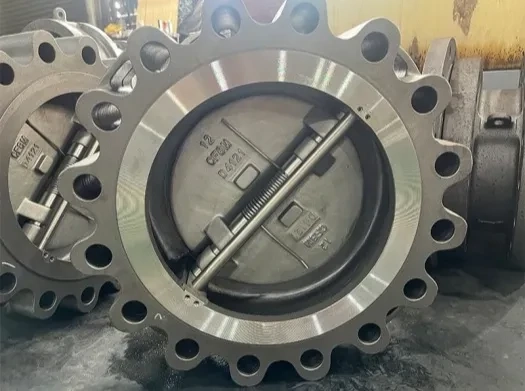
API 594 covers check valves in flanged, lug, wafer, and butt-welding configurations. The standard defines two types: Type A for short face-to-face dimensions and Type B for long face-to-face dimensions. The dual plate valve falls under Type A, which is the compact body style designed for tight piping layouts.
The standard covers design, materials, face-to-face dimensions, pressure-temperature ratings, inspection, examination, and testing requirements. The obturator may be single or dual plate, swing disc, or pivoting disc. For dual plate valves, API 594 sets the minimum body wall thickness, the seat design requirements, and the testing procedures. Valves are typically tested to API 598 for inspection and testing.
API 594 dual plate check valves are rated to ASME B16.34 pressure classes, commonly from Class 150 to Class 2500. Face-to-face dimensions follow the standard's tables, which ensures that a valve from one manufacturer can be replaced by a valve from another without modifying the piping. That interchangeability matters in refineries and chemical plants where spare parts need to fit existing installations.
A Wafer Check Valve that complies with API 594 gives you a standardized envelope for design and a tested pressure boundary. The lug stainless steel dual plate style combines that compliance with the end-of-line mounting capability and corrosion resistance that stainless steel provides.
Stainless steel dual plate check valves are used in applications where carbon steel would corrode. The common grades include CF8 (304 stainless steel) and CF8M (316 stainless steel) for the body, with plates made from the same or similar grades. CF8M provides better resistance to chlorides and chemical attack than CF8, which makes it the standard choice for chemical processing, seawater service, and pharmaceutical applications.
The internal components — hinge pin, springs, and plate stops — are also made from stainless steel or corrosion-resistant alloys. If the process fluid is abrasive, the seat and plate edges can be hard-faced with materials like Stellite to resist erosion. The material selection depends on the fluid chemistry, temperature, and the expected service life.
Stainless steel dual plate check valves show up in chemical plants, refineries, water treatment facilities, pharmaceutical manufacturing, and food processing. The common thread is a fluid that would corrode a carbon steel body or contaminate a carbon steel surface. In food and pharmaceutical applications, the stainless steel construction allows for cleaning and sanitizing without damaging the valve.
Dual plate check valves are installed wherever reverse flow needs to be prevented without adding a long valve body to the piping layout. Common installation points include:
Pump discharge lines — preventing backflow when the pump stops, protecting the pump from reverse rotation
Compressor discharge lines — blocking reverse gas flow when the compressor shuts down
Process piping — isolating sections during maintenance and preventing cross-contamination between process streams
Tank and vessel inlet/outlet lines — preventing backflow into the tank when the supply stops
Utility lines — steam, condensate, and cooling water systems where reverse flow would cause water hammer
The lug style is particularly common on pump discharge lines because the valve stays in place when the pump is removed for service. The stainless steel construction handles corrosive fluids in chemical and pharmaceutical plants.
Size the valve to match the piping line size. A valve that's too small creates a pressure drop and restricts flow. A valve that's too large may not open fully at low flow rates, which causes the plates to flutter and wear prematurely. The valve should be sized for the expected flow range, not just the line size.
For most corrosive fluids, CF8M (316 stainless steel) is the baseline choice. For highly corrosive media or chloride-rich environments, duplex stainless steel or alloy 20 may be required. Check the fluid chemistry against the material's corrosion resistance chart before specifying. The plate and seat materials also matter — a hard-faced seat resists erosion from abrasive particles in the fluid.
The lug valve bolts to one flange using the threaded lugs. Make sure the flange facing matches the valve's face — raised face, flat face, or ring joint. Tighten the bolts in a star pattern to compress the gasket evenly. Check the flow arrow on the valve body to confirm the forward flow direction, and verify that the plates swing freely before bolting the valve into the line.
Inspect the plates and seat for wear or erosion. Check the springs for fatigue — a weak spring won't close the plates quickly enough, which can cause water hammer. Clean the valve body if the fluid leaves deposits or scale. The hinge pin and plate stops should be inspected for corrosion or binding. In most clean-service applications, the valve runs for years without maintenance.
A Wafer Check Valve in the lug stainless steel dual plate style should match your line size, pressure class, fluid chemistry, and piping layout. The Lug Stainless Steel Dual Plate Check Valve from TSV Valve uses spring-assisted dual plates for quick closure, complies with API 594 for design and dimensions, and is available in stainless steel grades for corrosive service. The lug body bolts directly to one flange, making it suitable for pump discharge and end-of-line applications. If you're specifying a check valve for chemical, refinery, or process piping, send us your line size and fluid requirements — we'll help you confirm the right configuration before you order.
Previous: NULL
Related News



E-mail: info@tsv-valve.com

Telephone: +86-13695850057

Whatsapp: +86-13695850057

Address: TianSheng Industrial Park,Dong'ou Industrial Zone,Oubei Town,Wenzhou City,Zhejiang Province,China