- Email:info@tsv-valve.com


 Nov 11,2026
A Non-Rising Stem Knife Gate Valve solves a specific installation constraint: the valve opens by pulling the gate upward inside the body, while the stem stays where it is. You'll see how that differs from a rising-stem design, what the beveled gate and self-cleaning seat do in slurry service, and how the TSV format envelope reads for a pipeline spec.
Yes. In a non-rising stem design, the stem rotates in place while the gate travels along the stem threads inside the bonnet. The stem itself does not extend above the handwheel or actuator housing. The page describes the TSV knife gate as available in both rising stem and non-rising stem configurations, and industry references note that non-rising stems are used where vertical space is limited. That's the functional difference: a rising stem grows taller as the valve opens, while a non-rising stem keeps the same overall height through the full stroke.
It changes the maintenance access, not the maintenance need. A rising stem exposes the stem threads above the bonnet, so lubrication and inspection happen on the visible stem. A non-rising stem keeps the threads inside the bonnet, protected from the environment. The TSV page lists a bolted bonnet design for non-leakage through the packing chamber, which means the bonnet can be removed for internal access without cutting the body out of the line. For a valve installed in a congested pipe rack, that bolted bonnet is the maintenance path.
The knife gate's defining feature is the gate itself: a thin, sharp-edged plate that cuts through the medium rather than pushing it aside. The TSV page describes a beveled knife on metal or resilient seats, with a self-cleaning mechanism.
In slurry service, the failure mode for a standard gate valve is the seat pocket—the recess where the gate sits when closed. Solids settle into that pocket, and the gate cannot fully seat on the next closure. The knife gate avoids that by having no pocket for solids to collect. The page states the valve body does not actually have a chamber, and the gate is raised and lowered in the side guide groove and pressed on the seat by the bottom lug. That geometry is what makes the valve self-cleaning: there is no cavity for the medium to accumulate, so the gate wipes the seat clean on each stroke.
A beveled edge concentrates the closing force on a narrow line, which is what allows the gate to cut through fibrous or particulate material rather than binding on it. The page lists a beveled knife as a key feature, paired with a uni-directional design. In a pulp line or a wastewater channel, that cutting action is what prevents the valve from jamming half-closed on a rag, a fiber bundle, or a piece of debris.
The TSV non-rising stem knife gate is available in wafer and lugged body styles, with sizes from 2" to 48" (DN50 to DN1200) and pressure ratings of Class150 or PN6 to PN16. The material list covers carbon steel and stainless steel grades, so the valve can be matched to the medium's corrosivity as well as its solids content.
| Parameter | TSV non-rising stem knife gate |
|---|---|
| Size range | 2"–48" (DN50–DN1200) |
| Pressure rating | Class150 / PN6–PN16 |
| Body materials | WCB, LCB, WC6, CF8, CF3, CF8M, CF3M, 4A |
| Gate style | Beveled knife, metal or resilient seat |
| Seat design | Self-cleaning, no body chamber |
| Stem configuration | Rising or non-rising (optional) |
| Body style | Wafer or lugged |
| Bonnet | Bolted, non-leakage through packing chamber |
| Operation | Manual, gear, pneumatic, hydraulic, electric |
| Design standards | MSS SP-61, ASME 16.34 |
| Face-to-face | MSS SP-81, ASME B16.10, EN 558 |
| Connection | ASME B16.5, EN 1092, JIS B2220 |
| Test standard | MSS SP-81 |
The wafer lugged body is the installation format that pairs with the non-rising stem. The lugged design lets the valve be bolted between flanges with additional support from the lugs, which is the arrangement suited to a line where the valve is supported by the pipe rather than by a separate stand. The page describes the wafer lug type as designed for installation between flanges using bolts, with the lugs providing support and alignment.
WCB is the baseline carbon steel for non-corrosive slurries. CF8 and CF8M are the stainless options for corrosive media, and the 4A grade is a duplex stainless for chloride-bearing service. The gate material is listed separately from the body material in the page's construction description—stainless steel or hardened steel for abrasion resistance—which means the wetted body and the cutting edge can be specified to different requirements.
The non-rising stem's practical benefit shows up at the installation drawing. A rising-stem valve needs clear vertical space above the handwheel equal to the gate's travel plus the stem's thread length. In a pipe rack with a ceiling, a walkway, or another pipe run directly above the valve, that clearance may not exist.
Low-clearance pipe racks: no overhead space needed for stem travel
Below-grade vaults: the valve stays within the vault height
Dense skids: the actuator and handwheel stay at a fixed elevation
Buried or covered installations: no stem extension to protect or seal
Retrofit work: the valve fits an existing envelope without raising the pipe
Confirm the face-to-face dimension against the pipeline gap, the flange drilling against the mating flange standard, and the operation method against the available access. The page lists MSS SP-81, ASME B16.10, and EN 558 as face-to-face standards, so the valve can be specified to match the existing pipe spool rather than modifying the spool to fit the valve.
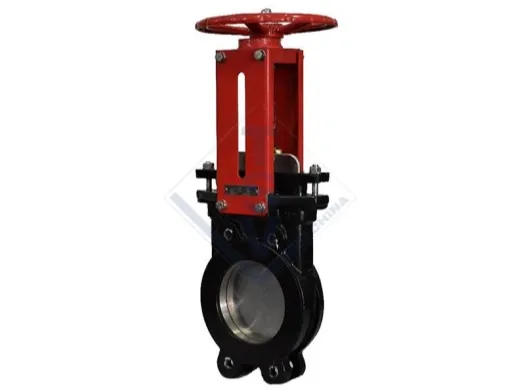
The TSV non-rising stem knife gate is built around the service conditions the page describes: slurries, viscous fluids, and systems with high solids content in mining, wastewater treatment, pulp and paper, and chemical processing. The beveled gate cuts through fibrous material, the self-cleaning seat has no chamber for solids to settle, and the non-rising stem keeps the valve within a fixed vertical envelope. The wafer lugged body, the 2"–48" size range, and the WCB-through-CF3M material list give a specifier a valve that can be matched to the line's pressure class, corrosion profile, and available space. For a Non-Rising Stem Knife Gate Valve in a congested pipe rack or a low-headroom vault, the value sits in the installation envelope: the valve does its full stroke without the stem ever extending above the actuator.
Confirm the size and pressure class against the line, the body material against the medium's corrosivity, and the seat material against the solids content and particle shape. The page's self-cleaning design addresses solids accumulation, but the medium's chemistry determines whether a carbon steel body or a stainless grade is the right starting point. A review of the actual slurry composition against the material list is the step that turns the catalog range into a specified valve.
Send over your line size, pressure class, medium composition, and available vertical clearance—we'll help you check them against the TSV non-rising stem knife gate's 2"–48" size range, wafer or lugged body, and material options. Talk to TSV Valve about your Non-Rising Stem Knife Gate Valve requirements and get a specification-level answer before you commit to the pipeline.
Previous: NULL
Related News



E-mail: info@tsv-valve.com

Telephone: +86-13695850057

Whatsapp: +86-13695850057

Address: TianSheng Industrial Park,Dong'ou Industrial Zone,Oubei Town,Wenzhou City,Zhejiang Province,China