- Email:info@tsv-valve.com


 Apr 25,2026
A floating ball valve does not anchor the ball rigidly in place. Instead, the ball “floats” between two spring‑loaded seats. When you close the valve, upstream line pressure pushes the ball against the downstream seat, creating a seal that actually gets tighter as pressure increases. That is a fundamental advantage for any high‑pressure or high‑cycle application. This guide explains the physics of the “floating” design, the safety features that make it suitable for flammable and hazardous media, and the testing regimes that separate a reliable valve from one that will start leaking after a few thousand cycles. You will also see how one manufacturer turns decades of experience into a product that meets API 6D, CE, and API 607 fire‑safe requirements.
In a standard gate or globe valve, the closure member is fixed to a stem. In a floating ball valve , the ball is suspended in the fluid stream and kept in position by the compression of two elastomeric seats against it. When the valve is closed, the pressure of the upstream fluid pushes the ball firmly against the downstream seat, creating a seal that becomes tighter as the line pressure rises. This is often referred to as the “upstream pressure‑assisted sealing” effect.
The downstream seat, which is usually made of PTFE or an advanced polymer, is deformed slightly by the ball, providing a bubble‑tight seal even at very low differential pressures. The same principle also allows the valve to be bidirectional: if fluid flows from the opposite direction, the ball will simply seat against the other side. This simple but effective mechanism gives the floating design excellent shut‑off capability without requiring complex trunnion bearings.
What separates a basic floating ball valve from a truly rugged industrial component is the attention to safety details. The following features are standard on well‑designed valves used in oil, gas and chemical service.
If a valve suffers a sudden pressure spike, the stem can be forced upward, blowing out of the body. To prevent this, the valve uses a “blow‑out proof” stem design: a shoulder is machined into the lower part of the stem. Even if the stem packing fails, the shoulder contacts the valve body and prevents the stem from being ejected. At the same time, a thrust bearing at the shoulder forms an inverse seal that stops internal leakage in the event of a fire. For a floating ball valve handling flammable gas or hot oil, this is not a “nice to have” – it is a safety requirement.
Soft seats (typically PTFE) provide excellent sealing at normal temperatures but can be damaged by fire. A fire‑safe valve is designed with a secondary metal‑to‑metal sealing mechanism. When the primary soft seat is burned away, a graphite or metal back‑up seal contacts the ball and maintains a shut‑off, preventing the spread of fire and the uncontrolled release of product. The design also incorporates flexible graphite gaskets between the body and seat retainer, which remain sealing even after the elastomeric components have been destroyed. This type of construction is tested to API 607 and API 6FA standards.
Friction between the ball, stem, and PTFE seat can generate static electricity. In flammable atmospheres (hydrocarbon vapors, solvents, etc.), a spark could ignite the surrounding media. To avoid this, a static‑conducting spring is installed between the stem and the ball, and another spring between the stem and the body. Together they provide a continuous conductive path to ground, dissipating any accumulated charge. Any floating ball valve intended for petrochemical service should incorporate this feature, and many standards (including API 6D) explicitly require it.
The operating condition of a process line determines what kind of floating ball valve you need. There is no single “universal” metallurgy.
For general industrial (water, air, mild chemicals): ASTM A216 WCB (cast carbon steel) or A351 CF8/CF8M (stainless steel 304/316) are the most common body materials.
For lower temperatures (down to -46°C): LCB/LCC low‑temperature carbon steel is used.
For aggressive corrosion (seawater, acids): Nickel‑aluminium bronze or Duplex stainless steel can be selected.
For cryogenic LNG service (down to -196°C): Special cryogenic construction is required, including long bonnets to protect stem packing from extreme cold.
For extreme heat (up to 800°C / 1472°F): Metal‑seated ball valves with Stellite or similar hard‑facing alloys are used, along with graphite stem packing and metallic gaskets.
Seat and seal materials also vary. PTFE is the standard for general service, offering very low friction and excellent chemical resistance up to about 200°C. For higher temperatures, PEEK (about 250‑260°C continuous) or metal seats are used. The choice of material directly affects the maximum allowable working pressure and the valve’s life expectancy.
A valve that has never been pressure‑tested is a gamble. TSV follows a rigorous quality protocol covering incoming raw materials, in‑process inspection, and final performance testing.
All raw metal (castings, forgings, bar stock) is subjected to material certification review and, when required, positive material identification (PMI) to verify alloy composition. For critical low‑temperature applications, impact testing at -60°C or even -196°C is performed to ensure the material does not become brittle.
After machining, the valve components go through dimensional verification using digital calipers and coordinate measuring machines. Surface and subsurface defects are detected by non‑destructive methods such as liquid penetrant examination (PT) and radiography (RT).
All TSV valves undergo 100% hydrostatic shell testing (body and bonnet) at 1.5 times the rated pressure, with zero leakage allowed. Seat leakage is tested at 1.1 times the rated pressure; for soft‑seated valves, the acceptance criterion is zero visible leakage. Low‑pressure seat tests using air (0.5‑0.6 bar) are also performed to confirm sealing at low differential pressures. Testing follows API 598, API 6D and/or BS 6755 as required.
| Test type | Pressure | Acceptance criterion |
|---|---|---|
| Hydrostatic shell test | 1.5 × rated pressure | Zero leakage, no visible deformation |
| High‑pressure seat test | 1.1 × rated pressure | Zero leakage (soft seat) |
| Low‑pressure seat test | 0.5‑0.6 bar air | Zero leakage (bubble‑tight) |
For special orders, additional tests can be performed: high‑pressure gas testing, fugitive emission measurement, cycle testing (for high‑cycle service), and fire‑safe testing to API 607.
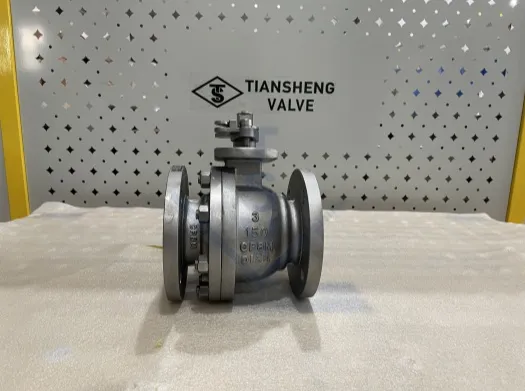
This type of valve is used in a wide variety of industries: water and wastewater treatment, oil and gas pipelines, chemical processing, power generation, LNG terminals, and pulp & paper mills. Its bidirectional sealing and compact design also make it popular for skid‑mounted systems and modular process equipment.
TSV, one of the established floating ball valve manufacturers in China, can supply standard products and also provide custom solutions: special body materials, non‑standard end connections, extended bonnets for cryogenic service, and actuation (electric, pneumatic, or gear operators). Their products are certified to API 6D, CE, and ISO 9001, and they can also supply valves meeting NACE MR0175 (sour service) and fugitive emission (ISO 15848) standards.
A floating ball valve that integrates a blow‑out proof stem, a robust fire‑safe design, and a comprehensive test regime is not a commodity product; it is an engineered component that contributes to long‑term operational safety.
When you evaluate a floating ball valve for your project, do not focus on price alone. Ask these questions:
Is the stem blow‑out proof? (Look for the shoulder design on the stem.)
Does the valve incorporate a fire‑safe mechanism (soft + metal secondary seal)?
Is there an anti‑static path between the ball, stem, and body?
What certifications are available? (ISO 9001, API 6D, CE, API 607.)
Can the manufacturer provide full documentation, including raw material certificates, NDT reports, and hydrostatic test logs?
For a plant manager or procurement officer, a well‑engineered valve that passes these checks is the valve that will still be working after tens of thousands of cycles.
【Contact TSV for a floating ball valve quotation or technical consultation】
Related News


E-mail: info@tsv-valve.com

Telephone: +86-13695850057

Whatsapp: +86-13695850057

Address: TianSheng Industrial Park,Dong'ou Industrial Zone,Oubei Town,Wenzhou City,Zhejiang Province,China