- Email:info@tsv-valve.com


 Aug 19,2026
You're standing next to a pipeline, and the valve needs to open—smoothly, reliably, without a struggle. A casting gate valve that fights you every turn or requires constant maintenance isn't just inconvenient; it's a liability. The manual cast steel gate valve was designed with a straightforward premise: turn the handwheel, the gate moves, the flow stops or starts. No complex actuators, no electronic controls to fail. But simplicity in operation comes from thoughtful design—a wedge-shaped gate that seals tightly, a stem that resists corrosion, and a bonnet that holds pressure without leaking. This article walks through what makes this valve genuinely easy to use and maintain, from the handwheel to the sealing surfaces.
Q: How does a manual gate valve actually work, and is it reliable?
A: The valve features a wedge-shaped gate that moves perpendicular to the fluid flow. Turning the handwheel rotates the stem, which moves the gate up or down to open or close the valve. The design is simple, robust, and highly reliable—there's no complex mechanism to fail.
Q: What materials are used, and how do they affect durability?
A: The valve is made from cast steel materials, including A216 WCB (carbon steel), A351 CF8 (stainless steel), and A351 CF8M (stainless steel with molybdenum). The stem is typically stainless steel or another corrosion-resistant material, ensuring long-term durability and resistance to wear.
The heart of any gate valve is the gate itself. The manual cast steel gate valve uses a wedge-shaped gate that moves perpendicular to the flow of the fluid. This design ensures a tight seal when the valve is closed, preventing leakage.
A wedge-shaped gate creates a mechanical advantage when closing. As the gate is lowered, the wedge forces the sealing surfaces against the seats, creating a tight, leak-proof seal. The more pressure from the fluid, the tighter the seal becomes—a self-energizing effect that simple flat gates can't match.
The valve is equipped with resilient seats that provide a tight seal against the gate. These seats ensure minimal leakage and long service life. When they eventually wear, they can be replaced—extending the valve's service life without replacing the entire unit.
The stem connects the handwheel to the gate and is responsible for moving the gate up and down. The bonnet is bolted to the valve body and houses the stem and packing.
The stem is typically made of stainless steel or another corrosion-resistant material. This isn't a component that will rust, seize, or fail after exposure to moisture or aggressive media. The stem's durability directly affects the valve's operating life.
The bonnet is designed to withstand the pressure and temperature conditions of the system. It's bolted to the valve body, not threaded—a design choice that provides greater strength and easier maintenance access.
The valve is operated manually, using a handwheel, lever, or gear. This isn't a valve that requires power, control systems, or specialized training to operate.
Turning the handwheel rotates the stem, which moves the gate up or down. The manual operation allows for precise control of the flow. You can open the valve fully for maximum flow, close it completely for isolation, or position it partially for throttling—all with a simple mechanical interface.
Manual operation means the valve works regardless of power availability. In emergency situations, during power outages, or in remote locations where electricity isn't available, the valve still functions. This is a significant advantage over electrically or pneumatically actuated valves.
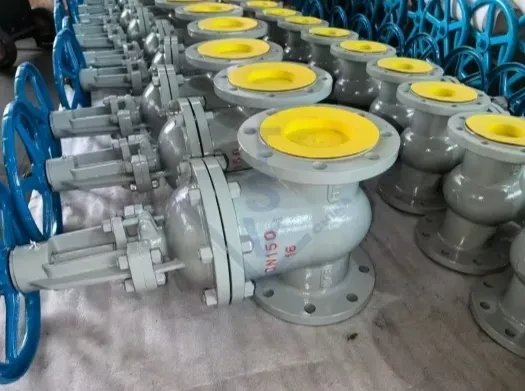
The manual cast steel gate valve is available in multiple material grades to suit different service conditions.
A216 WCB is the standard carbon steel grade for valve bodies. It's suitable for water, oil, gas, and steam applications at moderate temperatures and pressures.
A351 CF8 is the cast equivalent of 304 stainless steel, offering good corrosion resistance for less aggressive media. A351 CF8M is the cast equivalent of 316 stainless steel, with added molybdenum for improved resistance to chlorides and acids.
| Parameter | Specification |
|---|---|
| Size Range | 1/2 to 30 inches |
| Pressure Rating | 150 to 2,500 lbs |
| Materials | Carbon steel (A216 WCB), Stainless steel (A351 CF8, A351 CF8M) |
| Design Standard | API600, ASME B16.34 |
| Inspection & Test | API598 |
| End Flange Dimension | ASME B16.5 (NPS≤24), ASME B16.47 Series B |
| Butt-Weld Dimension | ASME B16.25 |
| Socket-Weld Dimension | ASME B16.11 |
| Face-to-Face | ASME B16.10 |
| Pressure-Temperature Rating | ASME B16.34 |
| Wall Thickness | API600 and BS1868 |
| Certification | API600, CE |
The manual cast steel gate valve is used in a wide range of applications where reliable flow control is essential:
In upstream, midstream, and downstream oil and gas operations, gate valves are used for isolation and flow control. The cast steel construction and resilient seats handle the pressures and temperatures of hydrocarbon service.
Gate valves are standard in water and wastewater treatment for isolating sections of piping for maintenance. The manual operation and simple design make them ideal for these applications.
In power plants, gate valves control cooling water, steam, and other services. The wide pressure and temperature range of the manual cast steel gate valve covers the requirements of both fossil fuel and nuclear power plants.
Chemical plants require valves that resist corrosion and handle aggressive media. The stainless steel options (A351 CF8 and CF8M) provide the corrosion resistance needed for chemical service.
The manual cast steel gate valve is designed and manufactured to recognized international standards.
API600 is the American Petroleum Institute standard for steel gate valves. Compliance with API600 ensures the valve meets the dimensional, material, and testing requirements for petroleum and natural gas service.
CE marking indicates the valve complies with European Union safety, health, and environmental protection requirements. For valves destined for the European market, CE certification is essential.
The valve conforms to multiple ASME standards: B16.34 for pressure-temperature ratings, B16.5 and B16.47 for flange dimensions, B16.10 for face-to-face dimensions, and B16.25 for butt-weld ends. This ensures compatibility with piping systems designed to ASME standards.
Q: What sizes are available?
A: The valve is available from 1/2 inch to 30 inches.
Q: What pressure ratings are offered?
A: Pressure ratings range from 150 to 2,500 lbs.
Q: What materials can the valve be made from?
A: The valve is available in carbon steel (A216 WCB), stainless steel (A351 CF8), and stainless steel with molybdenum (A351 CF8M).
Q: What standards does the valve meet?
A: The valve is designed and manufactured to API600, ASME B16.34, and is CE certified.
Q: How does the valve seal?
A: The wedge-shaped gate moves perpendicular to the flow, creating a tight seal against resilient seats when closed.
Q: What applications is the valve suitable for?
A: The valve is used in oil and gas pipelines, water treatment plants, power generation facilities, and chemical processing plants.
Q: Is the valve easy to maintain?
A: Yes. The valve features replaceable seats and packing, making maintenance straightforward.
A casting gate valve that's simple to operate and maintain makes a difference on any pipeline project. The TSV manual cast steel gate valve combines a wedge-shaped gate design, resilient seats, corrosion-resistant stem materials, and a bolted bonnet in a package that delivers reliable flow control without complexity. Available in sizes from 1/2 to 30 inches, pressure ratings from 150 to 2,500 lbs, and materials including carbon steel and stainless steel, it's built for the demands of oil and gas, water treatment, power generation, and chemical processing.
Whether you're specifying valves for a new pipeline or replacing existing units, the manual cast steel gate valve offers the durability, reliability, and ease of maintenance that pipeline engineers and procurement professionals require.
Contact TSV for a quote or technical consultation → their team can help you select the right material, size, and pressure rating for your specific application requirements. Get a gate valve that delivers simplicity without compromising on performance.
Related News



E-mail: info@tsv-valve.com

Telephone: +86-13695850057

Whatsapp: +86-13695850057

Address: TianSheng Industrial Park,Dong'ou Industrial Zone,Oubei Town,Wenzhou City,Zhejiang Province,China