- Email:info@tsv-valve.com


 Oct 28,2026
A conventional Globe Valves design seals the stem with packing—a compressed ring of graphite or PTFE that presses against the moving stem. That packing works, but it wears. As the stem cycles up and down, the packing degrades, and a path opens between the process fluid and the atmosphere. For steam, water, or benign fluids, a slow packing leak is a maintenance nuisance. For phosgene, hydrogen sulfide, or high-pressure steam, it's a hazard. The double-layer bellows seal changes that equation by welding a metallic barrier between the fluid and the environment, eliminating the sliding seal entirely. This article explains how the double-wall bellows isolates the stem, what the Co hardfaced seat contributes to shutoff, and what to verify when you're specifying a bellows-sealed valve for a hazardous or high-pressure line.
A bellows is a corrugated metal tube that flexes as the stem moves up and down. The bottom of the bellows is welded to the stem assembly, and the top is welded to the bonnet connection plate. That welding creates a continuous metallic barrier—no packing, no sliding contact, no clearance for fluid to escape.
The double-layer construction adds a second corrugated wall inside the first. If the primary bellows develops a crack after thousands of cycles, the secondary wall still holds the pressure boundary. That redundancy is what allows the valve to maintain zero leakage even when the primary barrier has reached the end of its fatigue life. The bellows are typically made from stainless steel, selected for corrosion resistance and fatigue strength.
The bellows seals the stem. It does not seal the seat. The seat sealing is handled by the disc pressing against the body seat, and that interface uses a Co-based hard alloy overlay for abrasion and corrosion resistance. The bellows and the seat are two separate sealing systems, and both have to perform for the valve to achieve zero leakage.
The valve is designed and manufactured to ANSI B16.34, with pressure ratings from Class 150 to Class 600 and sizes from 2 to 24 inches. The body materials are carbon steel and stainless steel, covering the corrosion requirements of chemical, petrochemical, and power generation services.
The pressure-temperature rating follows the B16.34 material group tables. For carbon steel at Class 300, the allowable pressure decreases as temperature rises, which is why the valve's nameplate rating has to be checked against the actual operating temperature, not just the line pressure.
The face-to-face dimensions follow ANSI B16.10, and the flange drilling follows ANSI B16.5. Those two standards determine whether the valve will fit into an existing piping system without spool pieces or adapter flanges. Butt-welding dimensions, where specified, follow ANSI B16.25.
| Parameter | ANSI Flanged Bellows Globe Valve |
|---|---|
| Type | J41H (W) (Y) |
| Pressure class | 150–600 lb |
| Size range | 2–24 inch |
| Body materials | Carbon steel, stainless steel |
| Design standard | ANSI B16.34, BS1873 |
| Face-to-face | ANSI B16.10 |
| Flange drilling | ANSI B16.5 |
| Pressure-temperature rating | ANSI B16.34 |
| Inspection and test | API 598 |
| Stem seal | Double-layer metal bellows |
| Seat hardfacing | Co-based alloy |
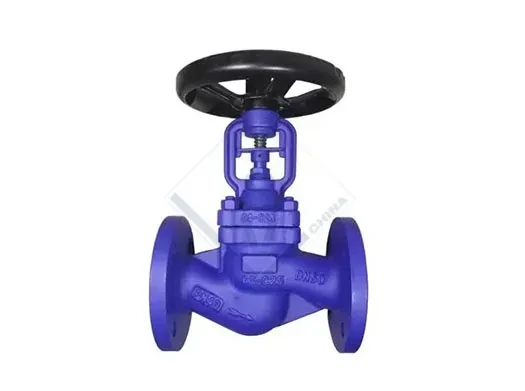
The seat surface is build-up welded with a Co-based hard alloy. That overlay gives the seat abrasion resistance, corrosion resistance, and anti-scuffing properties that a bare stainless steel surface cannot match.
When the disc closes against the seat, the Co alloy resists the galling and scoring that occur when two stainless steel surfaces slide against each other under pressure. The result is a seat that maintains its sealing geometry through repeated open-close cycles, even in steam service where the velocity across the seat can erode a softer material.
Globe Valves with a bellows seal are specified where fugitive emissions are unacceptable and where the fluid is toxic, flammable, or expensive. The application range covers chemical and petrochemical plants for corrosive and toxic fluids, power generation for steam and condensate systems, pharmaceutical and food industries where hygiene and leak-tightness are critical, and oil and gas for high-pressure and high-temperature service.
The common thread is a fluid that cannot be allowed to escape, and a valve that has to cycle repeatedly without developing a stem leak. A packed valve in those services requires constant monitoring and periodic packing replacement. The bellows-sealed valve removes that maintenance burden and the associated exposure risk.
Check the operating pressure and temperature against the B16.34 rating table for the selected material group. The valve is available from Class 150 to Class 600, and the allowable pressure at the operating temperature determines which class is adequate. A valve selected for the line pressure at ambient temperature may be undersized at 400°F.
The valve is inspected and tested to API 598. That standard defines the shell test and the seat test, including the allowable leakage rate. For a zero-leakage bellows valve, the seat test should show no visible leakage, and the shell test confirms the pressure boundary integrity.
The size range is 2 to 24 inches, with flange dimensions per ANSI B16.5 and face-to-face per ANSI B16.10. Confirm the flange drilling against the mating pipe flange, and verify the face-to-face dimension against the available space in the piping run.
The bellows is a welded component and is not field-serviceable. The valve is maintained by monitoring the stem position indicator and the seat tightness. If the bellows fails, the secondary wall maintains the pressure boundary, but the valve should be scheduled for replacement. The Co hardfaced seat can be inspected and re-lapped if the shutoff degrades.
A packing seal uses a compressed ring around the moving stem. It relies on contact pressure to seal, and it wears as the stem cycles. A bellows seal uses a welded metal barrier that flexes with the stem. There is no sliding contact between the seal and the stem, so there is no wear path for fluid to escape.
Yes. The bellows seal is particularly valuable in steam service because steam leaks are both an energy loss and a safety hazard. The Co hardfaced seat resists the erosion that steam velocity causes on softer seat materials. The pressure class and temperature rating determine the specific steam conditions the valve can handle.
A single bellows provides zero leakage until it fatigues and cracks. A double bellows provides the same zero leakage with a redundant second wall. If the primary wall fails after thousands of cycles, the secondary wall still contains the pressure. That redundancy is what allows the valve to be specified in services where a leak cannot be tolerated at any point.
The bellows material determines the upper temperature limit. Stainless steel bellows are suitable for the temperature ranges covered by the B16.34 rating tables. For service above the bellows material's fatigue limit, a different seal arrangement or a higher-alloy bellows may be required. Confirm the bellows material and the temperature limit against the operating conditions.
Globe Valves with a double-layer bellows seal should match your fluid compatibility, pressure class, and temperature range—not the other way around. The ANSI Flanged Bellows Globe Valve from TSV provides a welded double-wall stainless steel barrier against stem leakage, with Co hardfaced seating, ANSI B16.34 design and pressure-temperature ratings from Class 150 to 600, sizes from 2 to 24 inches, and API 598 inspection and testing. The valve is built for chemical, petrochemical, power generation, pharmaceutical, food, and oil and gas services where fugitive emissions are not acceptable. If you're specifying a bellows-sealed isolation valve for a hazardous or high-pressure line, send us your fluid, pressure, and temperature — we'll help you confirm the right pressure class and material before you order.
Previous: NULL
Related News



E-mail: info@tsv-valve.com

Telephone: +86-13695850057

Whatsapp: +86-13695850057

Address: TianSheng Industrial Park,Dong'ou Industrial Zone,Oubei Town,Wenzhou City,Zhejiang Province,China