- Email:info@tsv-valve.com


 Nov 19,2026
A Strainer in a process line usually stays in service for the life of the plant. The temporary version does the opposite—it goes in before commissioning, catches what the construction left behind, and comes out once the system runs clean. You'll see why that short service life is the design intent, how the TSV unit is built for it, and where the pressure rating and material envelope sit.
A permanent strainer is sized for the process flow and the expected pressure drop over years of service. A start-up strainer is sized to catch a one-time debris load—weld slag, rust, scale, and construction residue—that would quickly blind a permanent element. Leaving the temporary unit in place after commissioning would add a pressure drop the line wasn't designed for, and the captured debris would eventually restrict flow. The page describes the unit as designed for temporary use during pipeline startup, flushing, or commissioning, and notes that once the system is clean, the strainer element is removed.
The page lists the strainer's function as protecting downstream equipment such as pumps, compressors, and valves from damage caused by foreign particles. During commissioning, that debris is at its highest concentration—the pipework has just been fabricated and welded, and the first flow through the line carries the residue. The strainer sits upstream of the sensitive equipment and captures that material before it reaches the pump inlet or the valve seat.
The TSV temporary strainer is a wafer-type design, installed between two standard flanges. The page lists the size as 8 inches (DN200) and the pressure rating as Class 600 (PN100). The wafer format is what makes it a temporary device: it has no separate housing to bolt into the line, so it can be inserted between existing flanges during commissioning and removed the same way.
The page notes that gaskets are required on both sides to ensure seal integrity. That's the installation detail that matters for a wafer device—the strainer body sits between the two flange faces, and the gaskets on either side provide the seal. Without both gaskets, the joint leaks at the flange face rather than at the strainer element.
| Parameter | TSV Temporary strainer (from the product page) |
|---|---|
| Size | 8 inches (DN200) |
| Pressure rating | Class 600 (PN100) |
| Material | ASTM F316 forged 316 stainless steel |
| Connection | Wafer type, between flanges |
| Element design | Conical or cylindrical perforated plate / mesh |
| Gasket requirement | Both sides |
| Removal method | Pressure seam, after system shutdown |
| Applications | Chemical plants, oil and gas, power generation, pump suction pre-commissioning |
A flanged strainer with its own body requires a dedicated spool piece and two additional flange joints. A wafer strainer uses the existing flange pair, so the installation adds no permanent pipe length. When the strainer is removed after commissioning, the two flanges bolt back together with a gasket, and the line is left as it was designed. That's the "no permanent modification of the pipeline" point the page makes.
The material is ASTM F316 forged 316 stainless steel. The page describes F316 as offering superior corrosion resistance and high-temperature strength compared to carbon steel or 304 stainless steel, suited to harsh or chemical environments.
That material choice matters for a start-up strainer because the unit is exposed to whatever the line carries during commissioning—which may include cleaning chemicals, flushing water, or process fluid at temperature. A carbon steel strainer would corrode during that exposure, and the corrosion products would add to the debris load rather than remove it. F316 resists that, so the strainer captures the construction debris without contributing its own.
Material: ASTM F316 forged 316 stainless steel
Corrosion resistance: suited to chemical and marine environments
High-temperature strength: holds up in steam and hot process lines
Element: conical or cylindrical perforated plate or mesh
Pressure class: Class 600 / PN100
A forged body has a denser grain structure than a cast body, which matters for a pressure-containing part at Class 600. The 316 grade adds molybdenum to the alloy, which is what gives it the chloride resistance that 304 lacks. In a marine system or a chemical plant, that difference is the reason the strainer can sit in the line during commissioning without pitting.
The page describes the removal method: once the system is clean, the strainer element is removed via the pressure seam after system shutdown. The pressure seam is the feature that allows the element to be taken out without dismantling the flange joint.
That removal sequence matters for planning the commissioning schedule. The strainer has to be in place for the flush and the initial run, and it has to come out before the line goes into normal service. The page frames the maintenance step as requiring system shutdown—the line has to be depressurized and drained before the element is accessed.
Removal timing: after the system is confirmed clean
Access method: pressure seam, after shutdown
Line modification: none required, flanges reconnect after removal
Gasket replacement: new gaskets at reconnection
Inspection: check the captured debris to confirm the flush was effective
The material caught in the strainer is a record of what the fabrication left behind. Weld slag, mill scale, and rust flakes in the element confirm that the flush carried the debris to the strainer rather than leaving it in the line. Inspecting the element before disposal gives the commissioning team a check on the cleaning procedure—if the element is heavily loaded, the flush may need to be repeated.
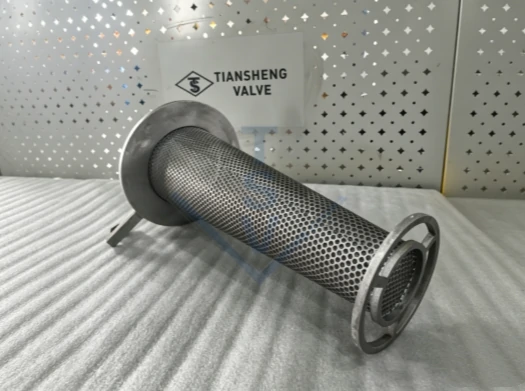
The Strainer from TSV Valve is built around the short-term protection role the page describes: an 8-inch Class 600 wafer body in ASTM F316 forged stainless steel, with a conical or cylindrical perforated element that captures weld slag, rust, and scale during pipeline commissioning. The page lists the applications as chemical plants, oil and gas pipelines, power generation steam and water lines, and pump suction pre-commissioning. For a commissioning engineer or a piping contractor, the value sits in the temporary format—the strainer goes in between existing flanges, protects the pumps and valves during the flush, and comes out through the pressure seam once the line is clean, leaving no permanent modification behind.
Confirm the line size against the 8-inch (DN200) body, the pressure class against the Class 600 rating, and the material against the process fluid's corrosivity. Check the flange standard against the mating flanges at the installation point, and confirm the gasket size for both sides. The page's specifications give the starting point; the line's commissioning procedure determines when the strainer goes in and when it comes out.
Send over your line size, pressure class, flange standard, and process fluid—we'll help you check them against the 8-inch Class 600 wafer body and the ASTM F316 material envelope. Talk to TSV Valve about your Strainer requirements and get a specification-level answer before you commit to the commissioning plan.
Previous: NULL
Related News


E-mail: info@tsv-valve.com

Telephone: +86-13695850057

Whatsapp: +86-13695850057

Address: TianSheng Industrial Park,Dong'ou Industrial Zone,Oubei Town,Wenzhou City,Zhejiang Province,China