- Email:info@tsv-valve.com


 Sep 23,2026
You're maintaining a pipeline system, and the strainer has collected its share of debris. If the filter element is welded or bolted in place, cleaning means cutting it out or disassembling the entire housing. A Basket Strainer with a removable basket changes that maintenance routine from a major operation to a quick service task. The Carbon Steel Basket Strainer from TSV features a cylindrical basket that lifts out for cleaning and reinstalls in minutes, reducing downtime and keeping your process running. This article explains how the basket design handles high debris loads, what carbon steel construction delivers in industrial environments, and what to verify before specifying a strainer for your piping system.
A basket strainer uses a cylindrical or basket-shaped straining element housed within a durable body. This design provides a large surface area for filtration, allowing efficient debris removal with minimal pressure drop. Compared to Y-strainers or T-strainers, the basket design offers a larger holding capacity for debris. The fluid enters through the inlet, passes through the basket-shaped straining element, and exits through the outlet. Solid particles and debris are captured by the basket, while the filtered fluid continues downstream. When the basket fills, it can be removed, cleaned, and reinstalled.
The basket design allows a larger volume of debris to be collected before requiring cleaning or replacement. In systems where the fluid carries a significant amount of solid particles — cooling water from lakes or rivers, lubrication systems, or chemical processes — this capacity translates directly to longer intervals between maintenance.
The cylindrical basket provides a large filtration surface area. The ratio of free area to pipe area for basket strainers is greater than for Y-strainers, which means less pressure drop across the strainer. For high-flow pipelines, this efficiency is essential to maintaining system performance.
Carbon steel is a popular choice for industrial strainers because it combines durability with cost-effectiveness. The Carbon Steel Basket Strainer is highly durable and capable of withstanding high pressures, temperatures, and harsh operating conditions. In facilities where the process fluid is not highly corrosive, carbon steel provides the structural strength needed to handle pressure surges and thermal cycling without cracking or deforming. The body material is fabricated steel, and the filter is SS316. The perforation pattern is made according to customer request, and the connection is ASME B16.5 Flanged 150Lb.
Carbon steel maintains its mechanical properties across a wide temperature range. Unlike some plastics or lower-grade alloys, carbon steel does not soften or become brittle under normal industrial operating conditions. This makes it suitable for steam, water, oil, and gas applications where protection from foreign matter is required.
For many industrial applications, carbon steel offers the best balance of performance and cost. It is more affordable than stainless steel or specialty alloys, yet it provides the strength and durability needed for most pipeline filtration duties.
| Parameter | Specification |
|---|---|
| Model | Carbon Steel Basket Strainer |
| Body Material | Fabricated Steel |
| Filter Material | SS316 |
| Size | 30 inch |
| Connection | ASME B16.5 Flanged 150Lb |
| Perforation | As per customer request |
| Strainer Type | Basket-shaped, cylindrical element |
| Basket | Removable for cleaning and maintenance |
| Applications | Water, oil, chemical, steam, gas |
The strainer is available with flanged, threaded, or welded ends to suit various piping systems. The ASME B16.5 flanged connection provides a robust, leak-free joint that can be disassembled for maintenance if needed.
The perforation pattern is made according to customer request, allowing the strainer to be tailored to the specific particle size and flow characteristics of the application. The mesh size and open area ratio can be adjusted to match the filtration requirements.
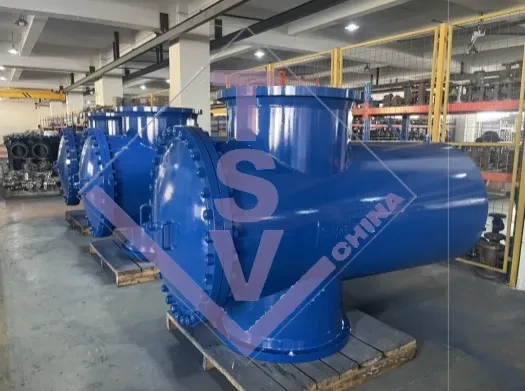
The Carbon Steel Basket Strainer is commonly used in industrial and commercial systems to protect equipment such as pumps, valves, and meters from damage caused by contaminants. It is widely used in water, oil, and chemical industries.
Cooling water systems — protecting pumps and heat exchangers from debris in water taken from lakes, rivers, or cooling towers
Lubrication systems — removing particles from oil circuits to protect bearings and gears
Chemical processing — filtering process fluids to prevent contamination of downstream equipment
Oil and gas pipelines — protecting meters, valves, and compressors from pipeline debris
Marine and offshore — seawater cooling lines and fuel oil systems
Cooling water systems often draw from natural sources that carry sand, silt, and organic debris. A basket strainer with high debris capacity keeps these particles out of the pumps and heat exchangers, extending equipment life and reducing maintenance costs.
Chemical plants and refineries use basket strainers to protect sensitive instruments and control valves. The carbon steel construction handles the pressure and temperature demands, while the SS316 filter provides corrosion resistance for the filtration element.
Basket strainers have a larger debris holding capacity and lower pressure drop than Y-strainers. They are typically installed in horizontal pipelines and are easier to clean because the basket can be removed. Y-strainers are more compact and can be installed in horizontal or vertical lines.
The mesh size depends on the size of particles you need to remove and the viscosity of the fluid. A finer mesh captures smaller particles but creates more pressure drop. A coarser mesh allows higher flow with less pressure drop. The perforation is made according to customer request, so you can specify the mesh size that matches your application.
Routine maintenance involves removing the basket, cleaning it, and reinstalling it. The frequency depends on the debris load in the system. A differential pressure gauge across the strainer can indicate when cleaning is needed — a pressure drop exceeding 2 psi through a clean strainer usually indicates the strainer is too small for the application.
The standard carbon steel basket strainer is suitable for many industrial pressure ratings. For higher pressure applications, alternative designs or materials may be required. Consult the manufacturer for specific pressure and temperature ratings.
A Basket Strainer with a removable filter, carbon steel construction, and SS316 basket element is the practical choice for industrial piping systems that need reliable filtration with easy maintenance. The Carbon Steel Basket Strainer from TSV delivers a large filtration surface for minimal pressure drop, high debris capacity for extended service intervals, a removable basket for quick cleaning, and ASME B16.5 flanged connections for secure installation.
Whether you're protecting pumps in a cooling water system, filtering oil in a lubrication circuit, or removing debris from a chemical process line, this strainer offers the durability and filtration performance that industrial operations demand. With customizable perforation and connection options, it adapts to your specific piping and process requirements.
Contact TSV for a basket strainer configuration assessment → their team can help you select the right size, mesh, and connection type for your specific fluid, flow rate, and particle size requirements. Get a Basket Strainer that keeps debris out of your equipment and keeps your process running.
Previous: NULL
Related News


E-mail: info@tsv-valve.com

Telephone: +86-13695850057

Whatsapp: +86-13695850057

Address: TianSheng Industrial Park,Dong'ou Industrial Zone,Oubei Town,Wenzhou City,Zhejiang Province,China