- Email:info@tsv-valve.com


 Jul 30,2026
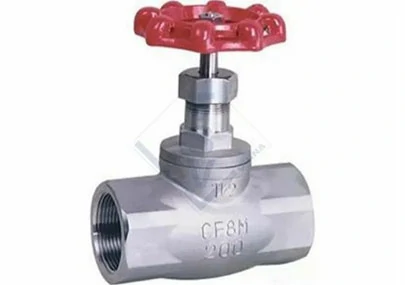
You’re specifying valves for a piping system—chemical processing, oil and gas, or water treatment. The application requires precise flow regulation, not just on-off control. A globe valve is the natural choice: its linear motion design and internal disk-and-seat structure make it ideal for throttling service. But among the many options, small-size threaded-end globe valves in CF8M stainless steel stand out for their corrosion resistance, ease of installation, and maintenance-friendly design. This guide covers what makes these valves different: the material advantages of CF8M, the practical benefits of NPT threaded ends, pressure-temperature considerations, and the applications where they excel.
Unlike gate valves, which are designed primarily for fully open or fully closed service, a globe valve excels at throttling—regulating flow rate with precision. The internal structure includes a movable disk-type element and a stationary ring seat in a generally spherical body. As the disk moves toward or away from the seat, it creates a variable orifice that allows fine control over flow. This makes globe valves the preferred choice for applications where flow rate needs to be adjusted frequently or where precise control is critical.
The linear motion of the stem and disk provides a direct relationship between handwheel turns and flow rate. This predictability makes globe valves easier to operate and more reliable for throttling than quarter-turn valves like ball or butterfly valves.
Globe valves are designed for single-direction flow control. The flow direction is typically indicated by an arrow on the body, and installing the valve correctly ensures optimal performance and seat life.
CF8M is the cast equivalent of 316 stainless steel, offering excellent corrosion resistance and chemical compatibility. It contains molybdenum, which enhances resistance to pitting and crevice corrosion in chloride environments—making it the material of choice for chemical processing, marine, and other corrosive applications. The body and bonnet of TSV Valve‘s small-size globe valve are each constructed of CF8M (316) SS, ensuring long service life even in aggressive media.
The molybdenum content in CF8M provides superior resistance to localized corrosion compared to 304 stainless steel. This is critical in applications involving chlorides, seawater, or acidic process streams.
CF8M globe valves handle temperatures from -20°C to 180°C (-4°F to 356°F), making them suitable for a broad range of industrial processes, from chilled water systems to steam and hot oil applications.
Threaded-end connections offer distinct advantages over flanged or welded ends, particularly for small-size valves. NPT (National Pipe Thread) is the standard tapered thread used in North America, providing a reliable, leak-tight seal when properly installed with thread sealant or PTFE tape.
Threaded ends eliminate the need for welding or flanged bolting, reducing installation time and labor costs. This is especially valuable in tight spaces or on existing piping where welding might be impractical.
When a threaded-end valve needs replacement or maintenance, it can be removed and reinstalled quickly without cutting pipe or disturbing adjacent equipment. This reduces downtime and simplifies routine maintenance.
Threaded ends conform to ANSI B 2.1, BS 21, DIN 259/2999, ISO 228, ensuring compatibility with standard pipe fittings.
Understanding the pressure-temperature limits of a valve is essential for safe, reliable operation. Small-size threaded globe valves are typically rated for pressures up to 800 PSI (approximately 55 bar) depending on size and temperature. The specific rating varies with temperature—higher temperatures reduce the maximum allowable working pressure. Always consult the manufacturer’s pressure-temperature chart for the exact rating at your operating conditions.
Small-size globe valves typically range from 1/2” to 2” (DN15 to DN50). This size range covers most instrumentation, sampling, and small-branch piping applications where precise flow control is required.
The CF8M body and PTFE seat materials typically support temperatures from -20°C to 180°C (-4°F to 356°F). For higher temperature applications, other seat materials may be available.
| Specification | Typical Value | Why It Matters |
|---|---|---|
| Body material | CF8M (316 SS) | Corrosion resistance in aggressive media |
| End connections | Female NPT | Easy installation, maintenance-friendly |
| Size range | 1/2” – 2” (DN15 – DN50) | Covers most small-branch applications |
| Pressure rating | Up to 800 PSI | Determines maximum working pressure |
| Temperature range | -20°C to 180°C | Suitability for process conditions |
| Standards | ANSI B 2.1, BS 21, DIN 259/2999, ISO 228 | Interchangeability and compliance |
Small-size threaded globe valves are used across multiple industries where precise flow control and corrosion resistance are required.
Chemical processing: Control of corrosive fluids in sampling lines and small-branch piping
Oil and gas: Throttling service on instrumentation and utility systems
Water and wastewater: Flow regulation in treatment plants and distribution systems
Marine: Seawater systems where corrosion resistance is critical
HVAC: Chilled water and hot water control in building systems
What is the difference between a globe valve and a gate valve?
A gate valve is designed for fully open or fully closed service with minimal pressure drop. A globe valve is designed for throttling—regulating flow with precision. If you need to control flow rate, choose a globe valve.
Why choose CF8M over CF8?
CF8M (316 SS) contains molybdenum, providing superior resistance to pitting and crevice corrosion in chloride environments. CF8 (304 SS) is suitable for less aggressive media.
What does NPT mean?
National Pipe Thread—a tapered thread standard used in North America for sealing pipe connections. NPT threads create a pressure-tight seal when properly installed with thread sealant.
Can a threaded-end valve be used in high-vibration applications?
Threaded connections can loosen under vibration. For high-vibration applications, consider using a thread-locking compound or selecting a flanged or welded-end valve.
Selecting a small-size threaded globe valve comes down to three factors: material compatibility (match your fluid), connection type (match your piping), and pressure-temperature rating (match your operating conditions). Request a quote or technical consultation → —TSV Valve‘s team can help you select the right CF8M globe valve for your specific application.
TSV Valve manufactures a comprehensive range of industrial valves, including the Small Size NPT Thread End CF8M Globe Valve. The valve features a CF8M (316 SS) body and bonnet for excellent corrosion resistance, threaded ends conforming to ANSI B 2.1, BS 21, DIN 259/2999, ISO 228, and a linear-motion design for precise throttling control. Available in sizes from 1/2” to 2” (DN15 to DN50), the valve is suitable for chemical processing, oil and gas, water treatment, marine, and HVAC applications. TSV Valve provides comprehensive technical support and responsive after-sales service. Connect with TSV Valve to discuss your size requirements, pressure ratings, and application conditions.
Related News



E-mail: info@tsv-valve.com

Telephone: +86-13695850057

Whatsapp: +86-13695850057

Address: TianSheng Industrial Park,Dong'ou Industrial Zone,Oubei Town,Wenzhou City,Zhejiang Province,China