- Email:info@tsv-valve.com


 Sep 03,2026
You're looking at a piping system where every component requires power, control signals, or operator attention—except one. A check valve sits in the pipeline, opens and closes automatically, and does its job without any external input. No electricity, no compressed air, no PLC signals, no operator intervention. This article examines what makes the check valve the ultimate "set it and forget it" component—from the physics of fluid pressure that drives its operation to the simple mechanical design that makes it one of the most reliable devices in any piping system.
Q: How does a check valve operate without any external control signal?
A: A check valve is a self-actuating device. It relies on the pressure of the fluid itself—when forward flow pressure exceeds the cracking pressure, the valve opens; when flow stops or reverses, the valve closes automatically. No sensors, no actuators, no control loops—just direct fluid pressure doing the work.
Q: What is cracking pressure and why does it matter?
A: Cracking pressure is the minimum upstream pressure required to open the valve. It's the threshold that determines when the valve responds to flow. If the cracking pressure is too high, the valve won't open under normal operating conditions; if it's too low, the valve may open when it shouldn't.
The check valve operates on a simple principle: fluid pressure differential drives the opening and closing action. No external actuators, no complex linkages, no power requirements—just the pressure of the fluid itself.
When upstream pressure exceeds the cracking pressure, the valve opens. When downstream pressure exceeds upstream pressure, the valve closes. This pressure differential is the only thing the check valve needs to function. The valve doesn't measure, compute, or decide—it simply responds.
With no external actuators, no complex linkages, and no power requirements, the check valve has fewer components that can fail. The valve opens and closes automatically based on flow pressure, eliminating the need for operator intervention or control systems. This simplicity translates to minimal maintenance and long service life.
The check valve operates using the medium's own pressure difference—no external energy required. This passive operation means the valve doesn't consume electricity or compressed air.
Unlike actuated valves that require continuous power to maintain position, the check valve consumes no energy during normal operation. It holds closed against reverse pressure with no power input, and it opens without any external energy source. In an era of rising energy costs, this is a significant operational advantage.
Because the check valve doesn't require control signals, it doesn't need to be integrated into a control system. No PLC programming, no wiring, no troubleshooting control loops. This simplifies system design and reduces installation costs.
The check valve's fail-safe operation is built into its design, not dependent on external systems that could fail.
When flow stops or reverses, the valve closes automatically—no control signal needed, no power required, no operator action needed. Gravity, spring force, or backflow pressure ensures the valve closes. If the control system loses power, the check valve still works.
By automatically preventing backflow, the check valve serves as a mechanical backup to active protection systems. Even if sensors fail or control systems malfunction, the check valve continues to protect the piping system from reverse flow. It's a layer of protection that doesn't require maintenance of external systems.
Selecting a check valve is straightforward compared to other valve types. There are no actuators to size, no control signals to specify, no power requirements to meet.
For actuated valves, selecting the right actuator size is a complex calculation involving torque, pressure, and operating conditions. The check valve requires no actuator, eliminating this entire step from the selection process.
The check valve doesn't need to be integrated into a control system. This reduces the complexity of system design, simplifies installation, and eliminates the troubleshooting of control loops.
The check valve doesn't require electricity, compressed air, or hydraulic power. This eliminates the need for power distribution, backup power systems, or pneumatic/hydraulic supplies.
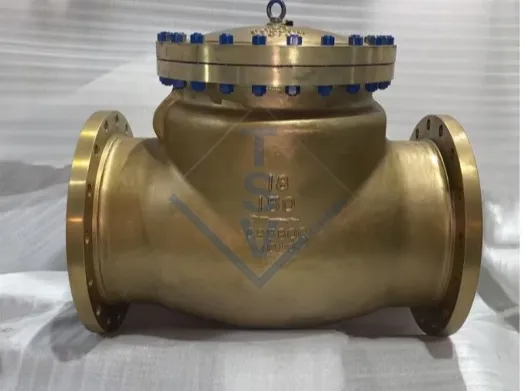
| Parameter | Bronze Flange Check Valve |
|---|---|
| Type | Lift check / Swing check |
| Material | Bronze |
| Connections | Flange, threaded, welded, clamped |
| Cracking Pressure | Specified per application |
| Operation | Automatic, pressure-actuated |
| Power Requirement | None (self-actuating) |
| Control Requirement | None (self-actuating) |
| Advantages | Simple structure, good sealing, energy-saving, cost-effective, long service life |
The check valve's "no power, no control" operation makes it particularly valuable in applications where external systems are impractical or unreliable:
In remote pipelines, offshore platforms, or unattended facilities, the check valve provides reliable backflow prevention without the need for power or control systems. It works even when no one is watching.
In fire protection and emergency systems, the check valve provides automatic protection without relying on power or control systems that could fail during an emergency. It's protection that doesn't require power to work.
In developing regions, temporary installations, or mobile equipment, the check valve provides reliable operation without the infrastructure required for actuated valves.
A: A check valve operates automatically based on fluid pressure. When forward flow pressure exceeds the cracking pressure, the valve opens. When flow stops or reverses, the valve closes automatically. No external power or control is required.
A: Cracking pressure is the minimum upstream pressure at which the valve will begin to open. It is specified based on the application requirements to ensure the valve opens at the right flow conditions.
A check valve that operates without external power or control is the simplest, most reliable way to prevent backflow in any piping system. The bronze flange check valve from TSV delivers self-actuated operation that requires no external power or control, simple design with fewer components that can fail, zero energy consumption during normal operation, fail-safe closure that works even when power is lost, and durable bronze construction for long service life.
Whether you're designing a water treatment plant, an oil and gas pipeline, or a chemical processing facility, the bronze flange check valve offers the simplicity and reliability that pipeline engineers require. In an era of increasingly complex systems, the check valve proves that sometimes the best solution is also the simplest.
Contact TSV for a quote or technical consultation → their team can help you select the right valve type, connection, and cracking pressure for your specific pipeline requirements. Get a check valve that does its job without asking for power, control, or attention.
Related News


E-mail: info@tsv-valve.com

Telephone: +86-13695850057

Whatsapp: +86-13695850057

Address: TianSheng Industrial Park,Dong'ou Industrial Zone,Oubei Town,Wenzhou City,Zhejiang Province,China